

The MAC Bego 600, an unusual name, and indeed a pretty unusual kite too. Not unusual in as much as the overall shape, but more in the details that go into making this an exceptional light wind kite.
First impressions centre on the drawsting bag that the kite arrives in - similar to a bag a kid would use for PE, only made from thinner material - quite a difference from the beautiful designer rucksacks that come from other manufactureres. I have to say it was not the most impressive piece of packaging I have come accross - but then MAC are a Czech company and perhaps looks don't count for much in Eastern Europe...

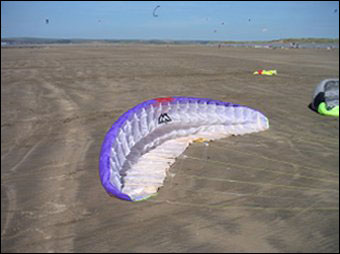
Opening the bag and pulling out the Bego for the first time I began to notice the clever touches that are reputed to set this kite apart from the rest. The first thing I noticed was the material - very thin and light - almost transparent, but still strong. This obviously keeps the overall weight of the kite down to a minimum, allowing it to fly in next to no wind.
Then you notice the great build quality from the stitching on the canopy to the stiched bridle lines - equal to any other manufacturer that I've seen. Clearly the quality that MAC puts into their paragliders extends over to their kites as well.
The cell openings have stiffeners along the edges which allow the cells to inflate very easily in low wind - winds where my BIII 4.9 simply flops over on the ground and refuses to inflate.
The brake bridle is interesting. The very end bridle attachment runs right to the trailing edge at the wing tip, but the next bridle in runs through an eyelet about six inches in from the tip and on to the tip itself. This has the effect of pulling the tip in toward the eyelet when the brake is applied on that side, MAC call this their 'rif-raf' - it makes turning extremely quick for a large kite and allows you to keep the power on full through a turn.
The Bego is one kite that really benefits from power rings - a short length of cord tied (10-12cm) on the main bridle leader, with a small ring (1cm diam) tied to the other end. The brake bridle leader is then passed through the ring and then connected to the lines. This keeps the brake lines nice and tight, which is key to getting the best from your Bego.
The brake lines should be adjusted on the handles so that you can see the trailing edge begin pulling down just as you apply a little brake. On the first flight (light wind initially please!) you will understand why MAC have gone to all the trouble of putting all these little features into this kite. The stiffeners cause the kite to inflate in the slightest wind, it just sits there inflated ready to go, pulling on the handles the kite takes off smoothly - the light material means it will fly in 2-3mph winds.
Immediately you feel the power this kite produces - it will pull you around in 3-4mph easily, with long scudds available in the power zone. In 5-7mph this is where the real fun starts and the true character of the Bego shows itself, dipping it into the power zone you can literally feel the power coming in - not a massive slam of power like a Blade - more a smooth progressive build up of power that makes it easier to time jumps, which are the party piece for the Bego.
It has masses of lift, perhaps not as much static lift as the Blade, but once you begin to move it around the window and get used to the fast, full power turns you can extract far more lift from the Bego.
In 10-13mph winds you are looking at huge floating pendulum jumps where you hang for a couple of seconds at least, and as you get used to the kite and the power the sky will, quite literally, be the limit. You still have this lovely creamy-smooth power delivery but it gets difficult to hold onto it in much stronger winds than this.
The real beauty of the Bego for me is that you need to spend time with it and learn how to get the best from it. You won't take it straight out of the bag and fly it to it's full potential - I don't care who you are. You need to explore its abilities, perfect the brake turning, hone your timing. It just makes you ache to get the thing out again and learn a little more. I'm not saying it's difficult to fly, it's not, you just need to fly it for a while to push yourself and the kite - this is why it is the most rewarding kite in my bag and always the one I want to fly first.
After a while you come to appreciate the simple functional statement that is the bag - I guess that's the point - every detail is there for a reason, if it doesn't improve the kite then it's not there. If you want the best light wind jumping kite there is then get a MAC Bego 600. If you want a nice bag get a Louis Vuitton...
By : Rob Lowe


Recommended Comments
Join the conversation
You can post now and register later. If you have an account, sign in now to post with your account.