
Search the Community
Showing results for tags 'Mac'.
Found 10 results
-
Bag, handles and lines: My Bego was supplied with a simple draw-string stuff-sack. Nothing unusual and the material is nice enough but in my opinion, the bag is a little tight for the 400, especially if you want to para-pack. It’s long enough to hold your handles and lines but not too wide so stuffing can be tight and your handles may hang out of the sack a bit if you don’t want to force them down. Additionally, the drawstring on my sack was originally too short to allow the sack to be fully opened. I cut it off and re-thread a new and longer string through to allow the sack to be fully opened. This is not a big deal. Mine came supplied with both Mac lines and handles and Flexi lines and handles. The Mac handles are simple PVC with foam padding. I’d say they are around ¾” or 2cm in diameter before the foam padding is added. They are very light and look cheap but I actually prefer them to the flexi handles. Their leader line is very skinny (2-3mm) and makes flying with the line between your fingertips rather painful but the leaders are extremely long with 7 knots in both the brake and power leader lines – not that you’d ever need that but it looks nice when harnessed in. These handles are roughly cut and can be sharp so I added stoppers to both the top and bottom of the handle to prevent them cutting the kite when stuffed. Though some may think they look cheap, I’ve got no problem with Mac handles (except for the thin leader line). I haven’t used the Mac lineset. It’s 30m (I’m told) and unsleeved and appears to be spectra. The brake lines are thin and maybe 150#. If I were to use them, I’d undo the knots and sleeve the brake lines so the knot doesn’t cut through the line. The power lines are sewn and have a thicker dimension (at least 300# but it’s a thickly braided line so its diameter may not be indicative of its total strength (or taughtness vs. stretchiness). No need to comment on the Flexi gear, as that is commonly available. Bridle: The kite is nicely bridled and the bridle material itself is of high quality. Bridle lines are sewn and attachment points are good. Because the kite is so thin in diameter (high A/R) when you unroll it, all the bridling seems to be a mess of spaghetti but it sorts out fine and I’ve never had the bridle snag or tangle. The brake bridle incorporates the “riff-raff” system, which is a sewn ring that the outer brake bridle leg passes through. If I recall correctly, this allows the kite to turn on its wingtip without shedding power by pulling the wingtip in during turns without collapsing it to allow the kite to accelerate through the turn without the loss of power. The kite will turn on a wingtip. Sail: The sail is very nicely sewn and the material is light and depending upon the color, semi-transparent. The cells are reinforced at their opening with mylar inserts to keep them open and in the proper shape allowing the kite to fill faster and launch more easily. There is no mesh or screen covering the cells. Internally, the kite is adequately cross-vented. Power Rings: Though not sold with them already installed, the seller I picked the kite up from gave me a set along with the kite and I’ve never flow it without them so I can’t tell you how the kite performs without them. Mine are Ronstan kite pulleys and I have them so they are adjustable from 2 – 6 inches in length. Both their position and length do affect the kite’s performance (too short and too high will make the kite turn rapidly but if you’re not on it, the kite can easily rotor and become difficult to recover). The sweet spot for me has become 6 inches long with the placement right on the second power leader knot. Cons: Let’s start here so we can focus the review on the best aspects of the kite. There are no dirt outs but that is not a major deal as the cells are large enough to dump sand and debris if needed. There are no croc-clips for the bridle. Not a big deal either but they would be nice because there is so much bridle for a thin kite. The kite is not overly bridled its just narrow so when folding up to parapack, it would have been nicer to have something to affix the leaders too. Especially since the power rings hold everything together close to the kite. The kite does have a tendency to backstall if you let it. I believe fliers call this the “bego flop”. Basically, the kite builds power by moving and using the brakes to pull it back into the power zone. If you let it charge it will go past the edge of the window and then stall and sink back to the ground (or collapse if you way out shoot the window). If this happens you’ll probably need to step off your board to pump it back into the air. You can prevent it from happening by riding the brakes. Performance: I’ve owned the kite for 7 months now and I’ve been power kiting for 2.5 years. In addition to this I fly a Blade and several JOJOs and my prime interests are skiing land boarding and static jumping. Originally I flew the kite on 11” handles. Those will work but because the kite needs to be flown on the brakes longer handles are better as they add more leverage and throw. At some point I switched to the longer HQ handles (15 or 17” – can’t recall) and the kite performs better with those (I don’t like Flexi handles which is why I haven’t used those). I suspect the paragliding background of Mac heavily influences the kite. By that I mean the kite wants to be right over your head (or just past vertical) and constantly pulling up. Upon launch the Bego wants to get to the top of the zenith and if you let it, it wants to fly just past the zenith so it is behind you (you’ll learn to prevent and control this with the brakes) and once there it wants to lift up and with a simple redirect, it certainly will. This kite wants to be high in the window and once there it pulls and pulls. You need to ride the brakes if you want to keep it low and in the power zone. Of the kites I own or have flown, this is the most fun to fly static. Jumping is a breeze and though it’s a 4m it has plenty of float and if you send it, the lift is great too. The kite needs to be flown on the brakes – not just for turning but also for tending and proper power delivery. The kite likes to be balanced on all four lines. If the powers go slack, the kite will implode and collapse and then likely reopen in the center of the window and power up dramatically. If you work the kite around too hard it will loose power (traction not lift) and if you loose brake tension it will fold. If your brake lines are saggy the kite will become sluggish and struggle through turns. If the brakes are tight the kite will be snappy and responsive. This kite requires that you fly it as opposed to being a kite that can simply be flown. Aside from the brakes being used for tending and turning, they are also your main method of building and delivering power, acceleration and traction. You can’t simply dip a Bego into the power zone and be off and boarding. Whereas the overhead lift is constant and readily available, you have to build the power for traction purposes. Instead of dipping it into the power zone and taking off, you have to lower the kite into the power and as you feel it build, pull the brakes in to retain the power and as you start to go, ease off. You want more power, pull the brakes in again and then ease off. More power still, repeat the process. You can “shift gears” on the Bego repeatedly, increasing power and speed exponentially. With a Bego, lift is pretty much always there but power (traction) needs to be drawn from the kite. Anyone can move this kite to the zenith and jump but if you want to use it for traction sports you need to know how to milk the power from it by tensioning and holding the brakes in or out as the kite builds power through the window. Because the kite wants to race to and out of the edge, you need the brakes to back it up and keep it in the power zone in order to build and deliver constant and progressive power. If you just dip it into the power zone, it will race to the edge with some but not full power, collapse as the lines slacken, drop back and then reopen with a major desire to go to the zenith and spank you. As I said, you need to FLY the Bego. The Bego builds traction power slowly and if you ride the brakes the kite will really get moving and as it moves, the power comes on but you need to harness and retain it. As such, it doesn’t like to be aggressively worked. You can’t throw it all over the window and expect it to keep pulling. You need to build the power by dipping it, parking it and then working it through the brakes. Acceleration is unbelievable and once going, if you send it back, it will take you up and float you down. Because the overhead pull is constant, you can’t help jumping if you redirect the kite back. Conclusion: Because of its gear shifting ability and enormous speed, I would think it would be a great buggy engine and it was a blast on skis on the frozen lakes this past winter. Because of its lift it has been a great kite to board with – though it does require attention so if you simply want to dip and go – you probably won’t like this kite as it requires more attention and flier input. I’ve heard other Bego owners say that the Bego is not a “point and shoot” kite and I would agree with that. You can point it but then you need to work and control it. It will take you where you want to go but not without direction. In summary, it is a very well built kite and it is unique. I’d highly recommend it to anyone who just wanted to static jump as I think that is one of its strong points. I’d do the same to anyone who wanted it for a buggy engine as it performs like a race kite (gear shifting and brake riding) but lifts closer to a Blade. I’d recommend a Bego to anyone interested in using it for boarding provided they understand that they can’t simply launch it, hook in and ride. You need to work the kite. In time, you’ll do it without thinking, but initially, that could prove frustrating. If want a kite that flies great but needs to be FLOWN get a Bego. It is a kite that you need to connect with but it also is a kite that really delivers the goods and gives you the feeling of being connected to the wind like no other. Author : Brian O
-
First Impressions: Basic draw string bag and nothing more. No safety leaflet, no sticker, nothing. A little disappointing as I especially like to see some documentation from the manufacturer to outline the safety precautions you should take and the wind ranges in which the kite can safely be used. Take the kite out of the bag, though, and things look up. The kite is obviously good quality; excellent double stitching all round, stiffened panels to help hold the vents open and a handy loop at each end to encourage turning by curling the edge of the kite slightly. Flexi handles, lines and killers provided with mine - all top quality. Setup : Being the first 4 liner I owned, I needed to set the kite up myself so began by equalising all the lines and going for a test flight in low winds. I don't really trust people to set up a kite in the store without seeing you fly as everyone's flying style is different. Had heard that the Bego's require some brake to really bring out the power so you will need to adjust yours to your flying style. Needless to say, the odd tweak here and there and you can up the output by about 15%! I have also added adjustable power rings to trim the kite slightly dependant upon the winds. Launching : I think the term is whooOOSH!!!! Straight to the zenith with no mucking about. You can tell from the word go that this kite begs to be flown. A little tricky to reverse launch properly but possible to get it off the ground sufficiently to turn it around and up with a little practice. This may be due to the need to balance the amount of power and brake you give the kite but I don't see it as a disadvantage - if anything it's taught me more about fine control of the kite. Flying : Fast through the air with positively ludicrous amounts of both pull and lift! Keep it low in the window and you accellerate into a skud so fast it takes your breath away, swing it up through the power zone and say goobye to the ground! Superb for landboarding and buggy jumping as well as static flying (although it's usually anything but static!). Naturally with this much performance it can get scary in gusty conditions but I've yet to have a completely involuntary lofting. I have, however, hit the deck pretty hard after a fantastic jump when the wind dropped - be careful! Turning is smooth and controllable and with the right input can turn about it's own centre axis with ease. Looks amazing in the air. Compared to other kites I've seen flying, you really get the feeling that this is completely solid once it's up - the kite fills completely and looks taught and ready to go. Gave it to a friend of mine who was determined to put to rest his own doubts as to whether it was indeed more powerful than his Blade II 4.9. Not sure what his full expression was as I only heard the first syllable before he face planted it! Suffice to say he was rather impressed - he now wants a 400! Landing : Brakes on, down it comes. What more is there to say? Can be a little tricky if you're really, really overpowered. Overall : Amazing kite. Phenominal power and lift from such a relatively small kite (remember this will easily out-do a Blade II 4.9 and the jury's still out on the Blade III 4.9). This kite never ceases to being a smile to my face and leaves you with a real feeling of exilleration. Be careful in gusty conditions though - it can bite! By : Jangla
-
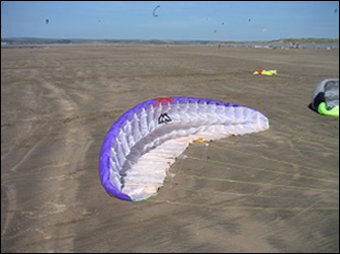 The MAC Bego 600, an unusual name, and indeed a pretty unusual kite too. Not unusual in as much as the overall shape, but more in the details that go into making this an exceptional light wind kite. First impressions centre on the drawsting bag that the kite arrives in - similar to a bag a kid would use for PE, only made from thinner material - quite a difference from the beautiful designer rucksacks that come from other manufactureres. I have to say it was not the most impressive piece of packaging I have come accross - but then MAC are a Czech company and perhaps looks don't count for much in Eastern Europe... Opening the bag and pulling out the Bego for the first time I began to notice the clever touches that are reputed to set this kite apart from the rest. The first thing I noticed was the material - very thin and light - almost transparent, but still strong. This obviously keeps the overall weight of the kite down to a minimum, allowing it to fly in next to no wind. Then you notice the great build quality from the stitching on the canopy to the stiched bridle lines - equal to any other manufacturer that I've seen. Clearly the quality that MAC puts into their paragliders extends over to their kites as well. The cell openings have stiffeners along the edges which allow the cells to inflate very easily in low wind - winds where my BIII 4.9 simply flops over on the ground and refuses to inflate. The brake bridle is interesting. The very end bridle attachment runs right to the trailing edge at the wing tip, but the next bridle in runs through an eyelet about six inches in from the tip and on to the tip itself. This has the effect of pulling the tip in toward the eyelet when the brake is applied on that side, MAC call this their 'rif-raf' - it makes turning extremely quick for a large kite and allows you to keep the power on full through a turn. The Bego is one kite that really benefits from power rings - a short length of cord tied (10-12cm) on the main bridle leader, with a small ring (1cm diam) tied to the other end. The brake bridle leader is then passed through the ring and then connected to the lines. This keeps the brake lines nice and tight, which is key to getting the best from your Bego. The brake lines should be adjusted on the handles so that you can see the trailing edge begin pulling down just as you apply a little brake. On the first flight (light wind initially please!) you will understand why MAC have gone to all the trouble of putting all these little features into this kite. The stiffeners cause the kite to inflate in the slightest wind, it just sits there inflated ready to go, pulling on the handles the kite takes off smoothly - the light material means it will fly in 2-3mph winds. Immediately you feel the power this kite produces - it will pull you around in 3-4mph easily, with long scudds available in the power zone. In 5-7mph this is where the real fun starts and the true character of the Bego shows itself, dipping it into the power zone you can literally feel the power coming in - not a massive slam of power like a Blade - more a smooth progressive build up of power that makes it easier to time jumps, which are the party piece for the Bego. It has masses of lift, perhaps not as much static lift as the Blade, but once you begin to move it around the window and get used to the fast, full power turns you can extract far more lift from the Bego. In 10-13mph winds you are looking at huge floating pendulum jumps where you hang for a couple of seconds at least, and as you get used to the kite and the power the sky will, quite literally, be the limit. You still have this lovely creamy-smooth power delivery but it gets difficult to hold onto it in much stronger winds than this. The real beauty of the Bego for me is that you need to spend time with it and learn how to get the best from it. You won't take it straight out of the bag and fly it to it's full potential - I don't care who you are. You need to explore its abilities, perfect the brake turning, hone your timing. It just makes you ache to get the thing out again and learn a little more. I'm not saying it's difficult to fly, it's not, you just need to fly it for a while to push yourself and the kite - this is why it is the most rewarding kite in my bag and always the one I want to fly first. After a while you come to appreciate the simple functional statement that is the bag - I guess that's the point - every detail is there for a reason, if it doesn't improve the kite then it's not there. If you want the best light wind jumping kite there is then get a MAC Bego 600. If you want a nice bag get a Louis Vuitton... By : Rob Lowe
 -
the neptune 400 wasn't my first mac para kite as i already have the bego 600.but as always the kite arrived in its small ripstop bag,no pretty rucksacks here.on spreading the kite out the build quality was excellent as on all mac kites,and the air intakes come to three,one in the centre then one each side equally spaced of which i was dubious of inflation.but on its maiden flight any doubts of inflation were quickly dispelled,the wind speed was only 6-8mph the kite quickly inflated a quick tug on the top lines and straight to the zenith no probs at all.as i already owned a bego flying the kite wasn't a problem, but for anyone buying a mac para kite for the 1st time they do take a while to get used to and have to be kept moving to get the best out of them. on my 1st jumps with the neptune 400 i was amazed @ how much lift you can get from the kite,and even more amazed @ how you just float down for such a small kite.next on the agenda was trying some body dragging in the sea as live on the coast,again this little kite amazed me on its pull and water relaunchability. yes i kept landing it in the water & relaunching it,and did leave it some 10 to 15 minutes and it still launched ok but would say 15 mins is its max as long as you don't have waves breaking on top of the kite.i was so impressed with the little neptune i went out & bought its sister the bego 400,which is marginally more powerful.i now have the neptune 600 which will get you up planing and jumping on a kiteboard.the neptune 400,and the bego 400 & 600. if you get the kite with cousin trestec lines your on a winner because they're simply the best. By : hankster
-
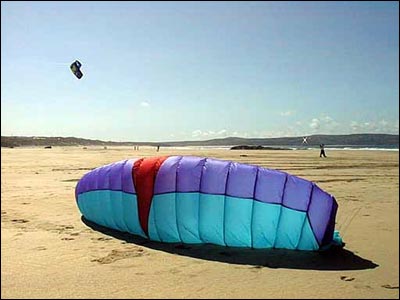 Extras: Ozone 25m lines and handles, optional power rings. Introduction Many of you will have heard about, read about, and even flown the Mac Bego. I had certainly heard a lot about it, but nothing about its sister kite, the Neptune (or Neptun as it says on the label), which is basically a closed-cell Bego. So I asked the man in the know, Al at Atmosphere Kites in Bristol, and decided it could be the kite for me. I was attracted by the promise of Bego-like flying characteristics and low wind capabilities combined with water relaunchability. The kite only has three cell openings on the leading edge and these have 'sock' valves in so they close up when the kite is inflated, preventing water (or sand) from flooding into the kite. I had a lot of questions, mostly concerning how good a closed-cell kite would be in light winds, presumably it would be harder to inflate through only 3 cells, but would stay inflated and so potentially be more stable. What You Get Supplied kite only, in a shiny ripstop stuff sack. Even from the outset the build quality looks good, the stuff sack has reinforcement around the cord hole and the cord itself is very smooth and soft to the touch, mmmmmmmmm First Impressions On taking the kite out of the bag it is apparent that the quality and attention to detail is incredible, this looks just like a scaled down paraglider. All of the bridle lines are fully sleeved and are individually cut to size (under tension I am told) with loops sewn into each end, making it very easy to replace a damaged line, or potentially to retrofit a depower system. The entire canopy is made of Porcher (sp?) ripstop which is very light, smooth and strong, and just generally feels expensive. Some of the colour schemes are a little, well, different, but the blue and white kites look pretty good I think, and I like the distinctive design. The bridle is a little different to the average foil kite in that it includes a riff-raff, a loop on the trailing edge through which a brake-bridle line passes so that the wing tip is pulled in a couple of inches on application of the brakes. It is possibly this that helps the kite turn so quickly, but I will get to that later. Setting Up and First Flight Using good quality ozone lines means checking the line lengths is a mere formality, and they are helpfully colour and number coded with the handles so even a newbie can get the lines in the right places, although hopefully not on such a large kite. I connected the lines to the bridle to give the setting with more brake, as I would rather the kite was over-braked initially than under-braked and difficult to land. Unfortunately this didn't pay off, more on that in a moment. In a smooth on-shore wind of around 8mph at a guess, the kite sat very tidily on the ground, staked through the handle brake loops, with no tendency to bounce or for the trailing edge to lift as it often does on my PKD Buster. The kite caught the breeze nicely and spread its wings, and what an impressive wingspan! I tried shaking the kite to inflate it a little, but not much happened, it seemed to inflate a touch so I thought I would try to fly it. On launching the kite leapt up, several feet, then started lurching around, spinning, flying backwards, and I couldn't do thing about it. I thought it would be alright once it inflated, but it never did, so I wrestled it back to the ground and my very helpful assistant pinned it down. I found the cause of this behaviour was that the sock valves inside the leading edge were all screwed up from when the kite was packed, so I fiddled around with these and jiggled them down the inside of the cell to straighten them out and open them up. Now the kite inflated more readily in the breeze, at least the leading edge filled out nicely. Now the kite launched, span around a couple of times, reversed a bit, inflated, powered up smoothly and flew straight to the zenith, and stayed there, whatever I tried to do. I had no brakes, and hence very little manoeuvrability, so I had to bring the kite down the side of the window and yank on the brake leaders to park it, whereupon it slid across the sand to sit neatly downwind of me. After a few more flights I had the kite set up a bit better, I had to shorten the brakes by about a foot on the leaders to get good response without any dragging on the brakes. Now the kite was set up better and the valves had opened out it was much easier to launch, it would just turn to one side on launching, inflate fully and then fly very nicely. Static flying with this kite is great fun, the power is very consistent and the delivery very smooth, it really gives the forearms a workout. Now to test the lift, the kite is very well behaved when sitting at the zenith, you can still feel the pull but it doesn't tend to lift you as I have found a Flexifoil Blade 2 does. Get the kite worked up for some jumping though and you won't be disappointed, after getting used to the slightly different flying characteristics, and the size of the kite, I found I could get huge floaty airs even in this breeze, and I'm no featherweight. Progression Having got the kite flying nicely and having gotten used to the way it flies I thought I had better get on the mountain board and have a go. The moment I did this I was gobsmacked, it seems this kite was designed purely for this purpose. Upwind runs were easy and fast, and downwind runs very controllable, the power delivery just feels superb for boarding. Unfortunately I have only managed a few runs on the board at the end of my first session with this kite, and a few more on a light wind day inland so I can't really say much more, but it feels good. Flying the kite inland a week later I was surprised how little wind it takes to get the kite inflated, shaking it for a while before launching seems to pay off as this inflates the kite well and makes it much easier to launch. Even in very low winds this kite flies well, it stays inflated and even gives reasonable power, enough for short scuds and small but floaty jumps, I'm not sure of the wind speed but I know I wouldn't have bothered getting my 4 metre Buster out of the bag. I got the kite tuned a little better as I found it wanted slightly more brake in lighter winds, now I am very pleased with its performance and can't wait to get going on the board again. I can't really comment on the water relaunchability, yet. The kite does stay inflated well, and when landed and staked it keeps its shape well, but still sits on the ground nicely, it does slowly deflate over the space of a few minutes, I think this should give plenty of time for a relaunch on water. One slightly strange characteristic I have found is that the kite occasionally wants to land, the kite will just power down and start to reverse, at first I could not do anything about this until the kite touched the ground, then it would take off again immediately. Now I can usually manage to turn the kite downwards and it speeds up again. I think this strange behaviour may have something to do with the kite losing the crease from its trailing edge, I think I will give the power rings a try and see if they can solve the problem. Conclusion Wow! What a stunning kite, I just love flying it, even in barely any wind it is fun, and for boarding it seems phenomenal. I can't wait to get more time flying it, especially on a nice open beach in smooth wind. I flew it again the following weekend, inland in very variable winds, it started off nice and gentle, but increased to perhaps 10-12 mph with some strong gusts, then I started to get a bit nervous, I tripped and got dragged a little, but overall the kite was still very smooth and predictable. At this point I decided to have a break, the wind settled at a steady-ish 10-15mph and I had a great day boarding with the 4m Buster. So I am very pleased with my new toy, it has been just as good as I hoped it could be. Many thanks to Al at Atmosphere for supplying the kite and telling me how to get it going. 3 months on... ...and I am very pleased with my choice. Having spent a good few hours flying over the summer, I have become accustomed to the kite and am much more confident flying it, and I stand by the sentiment of my conclusion above. I feel I should offer a few words of advice for anyone considering taking ownership of a Neptune: I found soon after writing the preceding sections of this review that this kite can be dangerous! Flying in very variable and gusty conditions is never fun, particularly not with a kite like this that takes a good while to get used to. Due to the fact that the closed canopy holds it shape when not flying forwards, the kite is very difficult to land smoothly and hold on the ground in strong winds. I managed to tear my kite apparently just through not being able to stop it bouncing quite violently on the ground in strong winds. This is a technical kite to fly, it can luff, and when it does, since it cannot collapse, it tends to turn inside out and accelerate towards the ground, the only way I have found to counteract this one is to get to know the kite better and not let it happen, checking it with the brakes as it approaches the edge of the window. Failing that, sprint towards the kite to get the lines slack, then, as it floats onto it's belly, run back again to pull the kite up forwards again, NB. this can result in some extravagant bowties! One thing this kite does not really suffer from is tip collapses during tight turns in light winds, the tips sometimes start to fold inwards a little, but due to the internal pressure they spring out again just as quickly. Having spent some time getting to know the kite and how to fly it, I can get it to behave itself much better and I have not experienced better performance from a fixed-bridle light wind kite. The closed cell construction does not reduce light wind launching capability, and in fact it makes the kite a lot more stable when open cell kites are tending to collapse and fall out of the sky. The use of power rings does seem to have eliminated the "Bego flop", where the kite wants to land, so I always use power rings on this kite. I have made a set of adjustable power rings using lightweight Ronstan pulleys to let the brake lines run smoothly. Short power rings (around 10-12cm) give good flight characteristics in light winds, and slightly longer ones (16-20cm) give improved lift in higher winds (perhaps 10mph plus at a guess). By : Gandy
 -
I wanted a Bego for a while, set me off when I saw a clip of a lad doing huge floaty jumps. I managed to get one second hand and what a kite it is. The kite is made of very light material which is almost transparant and the main thing is that it has stiffners on the front vents so it can inflate really rather easily. This does mean that you can fly in about 3mph winds however you do have to manipulate it to keep it going. The bag is ... ok, just like a drawstring PE bag. Its ok, no places to put your sarnies and can be a bit of a pain to carry but, your not flying the bag. Once it is set up correctly then you have a great kite. It can take a while to get the best out of it. I have had it for a good few months now and Im still finding out what I can do with it. On the rear of the kite a few inches in there is a little eyelet where the break lines go through and this allows you to pull pretty sharp turns for such a large kite. I found it pretty stable, it doesnt luff as much as my firebee and if you see it starting to, just tap the breaks and it will sort itself out. I have just started landboarding and I found it pretty good using the Bego. It has enough power where you can just put it in the spot and lean back and go without too much trouble. Wind ranges. Now anywhere from 6mph up you start to feel the force, 9 - 11 mph your going places and 12 - 14mph you will have trouble keeping your feet on the ground and your arms will pulled out of their socketsand youll have burning biceps, unless you get a harness. It doesnt have too much stactic lift, however you have to be careful of gusts that snatch you up. Once you get it moving about though you can get some good jumps. Jumping is pretty fun. When you get up you float down nice and gently and I weigh about 15 stone. Running backwards helps and you can do some pretty good slingshots. I think its a pretty good all rounder, I havent tried it in a buggy but its good on a landboard and when you get fed up of that you can try jumping and scudding so you wont get bord plus its a good light wind kite so you can get it out most of the summer and have fun. By : Rich83
-
Well where do i start i havnt been flyin all that long but i try to get out as often as possable so my quest for a big jumping kite came in off to the shop and away with a mac bego .the name is relativly unheard of but my god this kite kicks some serious ass!! i was a little let down by the bag (a normal drawstring stuff bag ) but as everybody says you dont fly the bag !! but once unpacked and self inflated in virtually no wind it looks a impresive bit of kit and well worth the money .the material is very stong and yet almost see thro my kite came in dayglow yellow with blue edges . i like the nice touches like the openings have been reinforced and keep there shape due to plastic like material sewn into it . i have only had the chance to fly it about 5 times and evertime i get more and more scared of it.its power is awsome im talking 35m scuds in 6mph winds !! we recently went to wales to fly and everybody who flys it agrees its a great bit of kit .i still havnt got mine set up correctly yet .they are a tempremental things to fly as they are very senstive and need to be flown with the brakes .but im assured once set up is a absoult dream.but as it is at the mo its plenty more than i can handle !!the kite has a tremendous amount of power and turns very quick for a big kite the best feature of this kite is the amount of lift it can generate . i was stood talkin to my friends with the kite at the top of the zenith and a very slight gust blew in and i was taken off the floor and was left hovering in mid air !this is a great kite and i would highly recomend one to anybody with a bit of experience. the shop i bought mine from are extremly helpfull and assist in teachin me how to fly it properly and are setting it up properly for me all i need now is very light winds so i can get some more time in on it this kite is best used for general traction fun scudding etc and jumps should imagine it would be a good buggy engine if you wanna go buggy jumping!! By : samupton69
-
This was my 2nd kite after the blade mk 1 3.3. First impressions of the kite when it arrives is the little drawstring bag it comes in, most other kite makers like ozone and flexifoil give you these nice expensive rucksacks, but then you don't fly the bag! I took it out of the bag when it arrived and it was nicely folded up, I unfolded it and it looked quite long and thin compared to other kites the other two things i noticed was the lightness of the kite and there these loops at the bottom which pull the edges of the kite in when you turn (very effective and stop the kite stalling as much). I bought mine from Al at atmosphere kites who set it up for me, lines and power rings. It took it out in about 5mph, took it out of the bag and then one pull of the handles and it went straight up to the zenith. It fills in very light wind due to these cell openings that have stiffiners along the edge to allow the cells to inflate very easily in low wind - winds where most other kites simply flop over on the ground and refuse to inflate. It had a great deal of power for the size of the kite and very quick turning, but to create power you had to work the kite very slightly and then it would come alive. Second time I took it out was about 15mph, so too windy really but it was a new toy so i had to try. I got some quite large jumps 10ft+ that were very floalty and huge long scuds that didnt seem to stop. i have also flown it back to back with a blade 4.9 and found that it was alot more stable and there was more lift and pull if you wanted it by simply dabbing on the brakes slightly (i have just tightened my brakes so it is also turbocharged). It flys very different to blades and i need to adjust my flying style but I think that it is a great kite and value for money. I would reccommend it to anyone wanting a meduim wind kite even though it will pull in the light stuff. So a great all round kite! By : Dylan
-
I just recently took reciept of my Bego 600. After drooling over it in the living room floor for a few days, I finally had a good first day lined up to fly. Packing One of the only complaints I have about the kite is the bag. It has a plain rip-stop bag with a draw string. But then again, Im not flying the bag, and can buy a ruck sack for about $20. Build This kite definitely has a very well build. I would put it right on par with Ozone kites. The kite is made from the same material as the frenzy. It has small stiff pieces of plastic-like material on the cell openings that keep them open and makes it inflate very easily. Each bridle line is sewn, not tied. Setup You will definitely have to add line tensioners, or power rings to this kite. Anyone flying a firebee already knows what Im talking about. Its a small ring on a string that attaches to the power bridle, and the brake bridle goes through it. I used 2 small pulleys I got from the local hardware store. The pulley itself is probably only about 1cm in diameter. Seems to work very well as there is no friction on the brake bridles. You have to adjust the brake lines on the handle leaders to get it all right. Once you do, lookout. Flying I flew it in 3-7mph winds. It goes right to the zenith and sits there. It does generate a good bit of static lift. But it generates much more when moving. In just the light wind we had, it still pulled very hard and had no trouble skudding by dipping it through the power zone. (I weigh 21st) It flys pretty quick and turns very very quicly for a kite of this size. You can very easily propeller it and make it spin on axis. NOT on wingtip, farther in, spinning in the middle. Its a super fantastic low wind kite. This thing pulls skuds when most kites are still on the ground. By : Scoopy
-
Double the power and lift of an equivalent Blade? Never heard of it! That's what I thought when I first bought mine - but lets have a look! Background MAC Para are big into paragliding racing and have been around for a long time. It is a well known make in the paragliding world. They started making foils many years ago, so this is not a new venture - just haven't bothered much with the UK as they thought there would be no interest. The Kite Firstly you get the kite in a standard draw string bag so no pretensions there. Unwrapping it you can see that this is a very well made kite from top materials. The 23 cells are all ventilated and have stiffener at the leading edge openings to help quick inflation, don't think I have that on any of my other kites. All the bridles have been cut under tension to give a better shape in the air. There are a couple of different arrangements on the bridling, the main lines are joined by a single lines to keep a good shape and the trailing edge tips have a brake line to them which goes through a ring so pulling the tips in for faster turning. My kite also has a karabiner power ring arrangement, similar to the Advance kites which keeps the shape and give more power. The colour of my kite is really distinctive yellow upper body with a purple leading edge and a large red diamond in the middle, the underneath is white with a MAC logo in the middle. Flying The first thing I noticed when flying this kite is that it loves to inflate and cannot wait to get going. This is the action of the cell opening stiffeners and the light material which also stops luffing. The Bego goes straight to the zenith on take off, no over- flying just straight up and will sit there all day. In winds over 8mph this can be followed by nice floaty jumps, so watch out. In more wind than that you will definitely get to see the world from a different altitude. The kite is easy to dip into the window and flies entirely using a small amount of brake for turning. It is fast and turns on its tip very quickly. This kite has enormous amounts of power which can be quite frightening in 10+mph wind - if that wasn't enough you can increase it by applying a small amount of brake across the window. This is the reason I use 30m 700/500lb lines. The one thing I have found which sets this kite out significantly from other 6m kites is that it is superb in low winds - firstly it will actually fly in 2.5mph - secondly it actually pulls scuds in 3mph+. This means that it has had a lot of time in the air this summer when I cannot get any other kites up. Conclusion This kite is so sweet to fly with ridiculous amounts of power and lift it has become one of my favourite all- rounder. It needs some setting to get the brakes perfect when you first get it. As in the Remington ad - "I liked the kite so much I bought the company" not quite but I have set up a shop to sell them.


