

Mountain, all-terrain or kiteboards come in all shapes, sizes and colours! With different trucks, wheels, tyres and bindings so if you are looking at getting into kiteboarding (please note the politically correct terminology) or upgrade your present board hopefully this guide will help you decide what you need.
Kiteboarding or mountain boarding is potentially hazardous to yourself and those around you. It is essential that you have the appropriate safety gear – as a minimum you will need a helmet (needs to have multi-impact protection and a CE certification), knee and elbow pads. For downhilling wrist protection is also a must (I would recommend wrist guards for kiting, but I know that it is almost impossible to hold the handles while wearing them – and that is quite important to!) suitable personal and public liability insurance are also recommended. Depending on what you are going to be doing and budget, crash shorts and body armour can also be worn.
It is also essential that your board is well maintained, that there are no loose bolts, there isn’t excessive play in the wheels on the axles, tyres are at a suitable pressure (I will go onto this later) and there is no critical damage to the board or any of its components (i.e. cracked or bent trucks).
Dependant on what level (price) of board you go for depends on what fittings you get, this is true of decks, trucks, wheels and tyres and bindings.
What size board?
The size of the board is important and is partly dependant on what you are going to be using the board for and your level of experience.
As a general rule, if you stand a board up on one end, the top truck should fall in between the tops of your thighs and the bottom of your ribs.
If you are into freestyle you may want a shorter deck (easier to rotate e.g. mbs comp 6, scrub 90 pro) and for cruising a longer deck gives you greater stability.
Your weight is going to effect how the deck flexes, so if you are of a bigger build a thicker, stiffer deck maybe for you (e.g. trampa custom deck, Scrub Regolith, MBS comp 26x).
Deck type.
It depends on how much you want to spend –
Laminated wooden decks are cheapest, and are probably the heaviest, they are flexible (the flex is dependant on the thickness and length of the deck) but can be damaged more easily (dents etc).
Wood and composite, mid range price, lighter, flex is dependant on what is put in the layers and not so much on length and thickness. Tougher than wood alone.
Full composite (no wood) most expensive, lightest (usually), again flex is dependant on the layers not length and thickness. Usually very tough and hard wearing.
Deck shape.
Deck shapes are a matter of taste but with a couple of factors that may influence your decision.
If you are going to be using or thinking of upgrading to channel trucks you will need to ensure the board has 35 degree kickers (the ends of the board that slope up) as this angle provides optimum pressure for steering.
Are you only ever going to use your board with a kite? Then flexifoil make kite specific boards with a heel side bias to stop you getting pulled down wind (seams a gimmick to me, IMHO, and a waste of a board). Get a regular deck and when the wind is not blowing have fun going down hill.
Trucks.
Different types for different uses and levels of experience (not in any particular order!)
Skate trucks
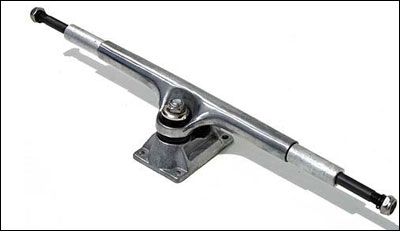
Light weight, simple to adjust and maintain, suitable for beginners, children, freestyle (though may bend with heavy landings), cheapest trucks, can be prone to speed wobble.
Scrub Channel trucks
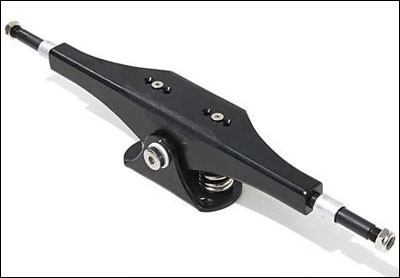
Stronger than skate tucks, but heavier (lighter than MBS matrix). Three way adjustment, more stable (no speed wobble. Suitable for heavier riders. Can be fitted with scrub brakes, but you will need 5 spoke hubs.
MBS Matrix Channel trucks
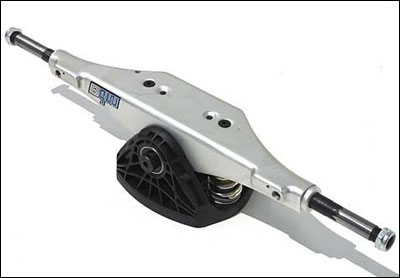
Strong, light weight, fully adjustable, stable, look cool, tends to be the choice of pro riders. Can be fitted with a MBS V brake.
Kitedeck Revolutions
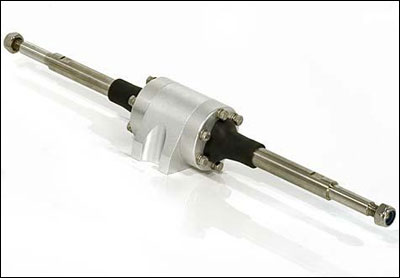
Designed for kite boarding, light weight, sealed unit - low maintenance, Adjustable with allen key or change bushes. Comes in different colours.
Ground industries Bionics
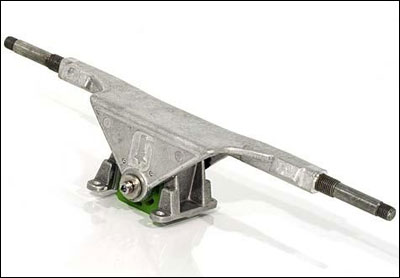
Versatile, strong, stable, change ride style by changing bushes.
Which ever type of truck you decide to go for it is important that you know how to maintain them and what to look for when parts need replacing, like changing springs, eggs shocks or bushes.
Wheels and tyres
Most boards come with a standard set of wheels, which include bearings, a spacer, tube and tyres. The hubs tend to be split, so if you get a puncture, to change the tube or fix it you need to undo the three or five bolts that hold the hub together. Don't try to use tyre levers as you will end up breaking the hub.
Hubs can be upgraded for lighter hubs, or the very cool Manhick alloy hubs, but you may have to change the bearings and spacers as well. For hubs that can take any size tyre you will need a set of primo strikers as these can take from 8inch to the massive 10 inch tyres (as used on no-snows). For the lightest tyres and hubs look at the MBS rockstar hubs and T1 tyres.
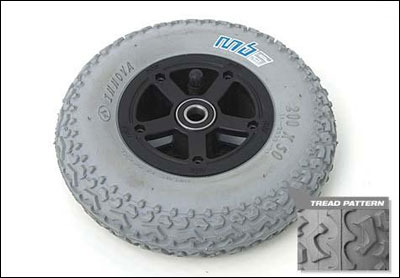
Tyres can also be changed for different tread, weight, size and colour (but check your hubs can take them). Bigger tyres for rougher ground and less rolling resistance.
A simple guide to getting the right tyre pressure is dependant on which finger you can press the tyre in with (this was explained to me by some top mountain boarders so does have some credibility)
middle finger = soft (less than 20psi)index finger = medium (20-40psi)thumb = hard (40-60psi).
Low tyre pressure is good for beginners, as it is slower and you get more grip, or in soft ground.
If you feel the need for speed go for high pressure (you also need high pressure with the Manhick hubs otherwise you can end up denting them - Not good at £110 for four!).
Bindings and grip tape
Bindings and grip tape provide increased control, they allow you to lean on to the board, applying pressure heel and toe side (which steers) without sliding or stepping off. When travelling at speed, over rough ground, in the wet or doing jumps you want to stay attached to the board so that you can maintain control.
The basic principle of using a mountain board bindings is locking your foot in - it doesn't matter what bindings you have. Undo the bindings, put your lead foot on the board as if you are going to ride and then lift your foot up - what happens? your foot goes in the air and the board stays on the ground! Now try again, put your foot on the board and then twist your foot so that your heel and toe are pressing against the binding posts/plate. Now lift you foot up and the board should come up with you.
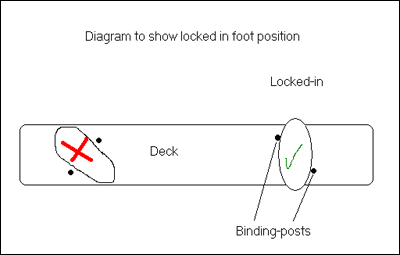
Now fasten you bindings as tight as comfortable or with freeflex bindings so that you can get you foot in and out (but not loose, you may need to wriggle your foot in).
I was initially advised when starting out to keep bindings loose so that I could step off the board if things got hairy. You must only ever mount or dismount a stationary board! If you try jumping off when the board is moving you are more likely to twist knees and ankles; damaging tendons, ligaments and bones. If you fall when strapped in everything moves together and you shouldn't get extreme torsion forces at knees and ankles.
Types of bindings - Freeflex, which are 2 posts (now being changed to plates on newer boards) and 3 layers of webbing and Velcro, when you have got them adjusted, tend to be left alone. Easy in and out therefore not massively secure. (Made by all manufactures).
Ratchet bindings - adjustable strap that wraps over your foot, slides into ratchet housing then tighten as much as needed. Comfortable and secure. (MBS f3, Scrub). My experience with the F3 bindings and a heel strap is that they can easily be done one handed.
Both of the above bindings can be used with heel straps (various designs and makes) for extra security, to prevent foot sliding out.
Or for total locked in riding either snowboard bindings or no-snow soft bindings (may not be suitable for kiteboarding!).
Grip tapes - these come in two main types, rubber and sand paper, if you are riding mainly on the beach then rubber is the recommendation; for grass and mud then sand paper is better. But often it may come down to personal preference or what the board comes with.
Footwear - this comes down to personal preference, some people prefer riding and recommend something with ankle support; personally I find that it effects my flexibility and that I can't get as low on the board as I like. When the ground is dry, I tend to wear skate shoes and in the wet I have a pair of light weight walking shoes, which are waterproof (to some degree) and provide extra grip.
Summary
Most people buy their boards as a complete package as this is more convenient and is often the most cost effective, hopefully this guide will give you some idea of what is out there and what to look for.
Though if you are up for it, all the board manufacturers do sell all the components separately, from the decks to the nuts and bolts so with some research you can get a fully customised board that meets your personal specifications. But how do you know what you want until you have tried a few things out?
Trampa will take your vital statistics and riding style and build you a completely customised board (including the deck thickness and length), this comes at a price (cost and IMHO the decks can be a bit heavy) but you get a bomb proof deck and all the components to suit you.
The golden rule is, if you can, try before you buy - at your local shop, board centre or flying site. You may not get to go downhill or be dragged a long by a kite, but stand on aboard, bounce around and have a play with the bindings just to try and get a feel for it.
Have a go on a gentle hill before you have a go with a kite (I know I would say that as an ATB instructor!) but learn to stop by powersliding, turn and control your speed, get your balance and get used to riding with your weight forwards. Talk to and watch other riders.

Recommended Comments
Join the conversation
You can post now and register later. If you have an account, sign in now to post with your account.