

Described by Flexifoil as "a new range of traction kites designed primarily for traction and competition kite buggying...for the serious buggier...great upwind performance", and more supprisingly as "the ultimate buggy kite". Described by almost everyone else as "past it".
Ok, to start with, lets get a few things straight here. The Viper is not a competition level traction kite. It is not for the serious buggier [Flexi, would you please define your definition of "serious"...?] It does not have great upwind performance and mostly it is not and never will be, the ultimate buggy kite.
OK, now I've got over that... is everyone sitting comfortably? Yes? lets begin...
Flexifoil were looking to replace its ageing SkyTiger range of traction kites. The poor old Tigers, had been around for quite a while, had been getting a little tired, and unfortunately had lost whatever impact they had on the race scene a long time ago. These poor old Tigers had to cash in their retirement plan and head down to London Zoo, put on their slippers, get out their pipes, and live out their remaining years in comfort with three good meals of wilderbeast a day. That's not to say the Tigers are a bad kite, just that technology has moved on, quite a long way on actually...
So, in an attempt to rplace his Tigers, Mr Flexifoil and his minions approached Peter Mirkovic [designer of the Predators] and asked if they could buy the licence to the very first predator, the mark 1. These, Peter happily sold with a big smile on his face, and Flexifoil have a new kite, Peter has a stack of cash, everyone is happy.
Problem is, when they were looking for the Tiger's replacement, they didn't want a damn good modern kite, Flexi wanted something that outperformed the SkyTiger in the buggy [not especially hard], but not something that would be better than their flagship, the Blade. And this is where the problems start, because the Blade is not a good buggy kite, its an allrounder. So, let me just clarify this, the Viper is a mark 1 Predator that has been fiddled with slightly. OK ? Good.
When the original mk1 Predator first came onto the traction scene, it was a great kite, and won just about every race that it entered. It completely walked all over the competition, and Peter knew he was onto a winner. After a while, other manufacturers developed kites that performed as good as, or better than the mk1, so the mk2 Predator was born and they started winning again. The Predator is now at mk3. The Viper is two generations behind, so lets not try and fool ourselves into believing Flexi's advertising hype. The Viper is not the ultimate buggy kite, nor is it designed for the serious buggier. A mk3 Predator can be described as being designed for the serious buggier.
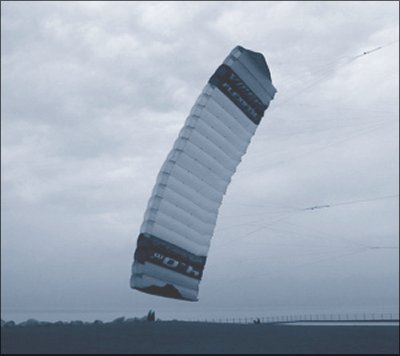
The most interesting thing you notice on first seeing the Viper is its shape. Most, if not all modern traction kites are bielliptic, while the Viper is rectangular (remember this is an old design.) and its construction looks to be uncomplicated. Made from Chikara ripstop, it has a slight taper on the trailing edge, the bridle material is unsleeved dyneema and on the final cell on each side of the kite, there is a section of chikara which flaps in the wind and annoys the hell out of everyone else on the beach. Over all, the build is up to the excellent quality that you would expect from Flexi.
 g
g
When in flight the kite has a slight curvature, and quite unsurprisingly looks remarkably like the mk1 Predator. It flies and turns quite slowly and gives a steady tug but feels quite heavy. You quickly get the feeling that this kite is not trying to catch you out and make you look like an amateur. A slight touch on the brakes brings in that extra bit of power the mk1 was always famous for. Many people have described the Viper as being diesel powered and this is just what it is like.
This kite is definitely a good choice for novice and junior buggy pilots who are just starting out or looking to upgrade their skill level. Or for the guy that is only around on a Sunday, when the weather is nice and spends all day pottering up and down the beach getting in everyone's way. If this type of flier were to buy a high performance race kite, they would just hurt themselves - start with easy kites and work your way up. And I'm not going to recommend it to buggiers who are moving on to the next level, because if they know what they are talking about, they would just laugh at me.
Unfortunately, there is no way I can say go out and buy one for several reasons.
I'm going to say this again, just so you understand. The Viper is not a high performance traction kite. It is not designed for competition kite buggying. It is not aimed at the serious buggier. It does not have great upwind performance and it is not the ultimate buggy kite. Don't believe a word Flexi tell you. Its all advertising crap.If you are thinking about getting one of these, bear in mind you are buying a copy of the old mk1 Pred. And, at the prices Flexi charge, you could get maybe two or three second hand mk1 Preds for the same price as a single Viper, this will allow you to buggy in a much wider wind range and have 3 times the fun.When you look at the price of Flexi's Viper when compared to the blade, there is very little in it. As I mentioned before, the Blade is not a buggy kite by any means. It is an alrounder. But it will let you buggy and mountainboard, skud, jump etc... Most importantly, if you buy a Viper, people on the beach will point and laugh at you. [including the little old ladies walking their blue-rinsed poodles.]
Overall:
Ok, for you people that can remember, what Flexi are actually doing, is akin to Compaq getting a ZX Spectrum, putting it into a new shinny box and telling everyone its the best computer available. And charging the same for it as the lastest technology. It just ain't going to happen. Don't be fooled.
By : racekites

Recommended Comments
Join the conversation
You can post now and register later. If you have an account, sign in now to post with your account.