
Search the Community
Showing results for tags 'Advance'.
Found 9 results
-
Advance Offroad This is a review looking back on 18months of hammering the Advance Offroads – it relates to the 2.4m, 3.8m and 5.4m. The characteristics are the same for these sizes. There is also a 7.1m (I’ve not flown it) and a mighty 10m – but that really was an experiment in light wind power, and we should steer clear. The Offroad is what you may call a freeride kite – like the Ozone Access or FS Rookie2 – but remember this was all happening with the Offroad over two years ago. Designed to work with handles or depower bar, the Offroad promised a safe, versatile traction engine for exploring backcountry snowkite areas. Its ease of use and lack of lift hinted at the potential of the kite to take the rider places suggested by its name… Build Quality This kite was designed by Robert Graham, the legendary paraglider designer that now works for Gin Gliders. This is a man who enjoys meticulous attention to detail. Remember this kite was made back in 04, the canopy is Porcher Marine Fabric – paragliders stake their lives on this stuff – and the leading and trailing edges are trimmed with rigid, shiny, Mylar. The bridles are sleeved in groovy Neon fabric but remain very supple with a superbly streamlined profile. Machinework is faultless – even the holes on the kites internal cell ribs are stitched. The bar set up is solid and simple. The chicken loop is a webbing type that larksheads onto your spreader bar – it works and requires no donkey stick to keep it in place. The safety sits between this and the bar, and is very easy to reassemble. The Spectra leader ends all have nice stitched ends rather than cheap tied and melted knots. Lines are coated, pre stretched, with stitched sleeves. The bridle pulleys are the same as those used on the new GK Sonic. The wrist leash is a sign of the times and works off the two back lines. The whole package is satisfyingly finished off with the discreet Advance logo stitched in many different places. In flight – general The Offroad is very easy to fly. It’s easy to feel the smoothness of flight after only a few seconds, but it will still hold your attention many sessions later when you have become too familiar with it. It has the ‘favourite’ kite quality. Put it where you want it in the window, and control it with the brakes – this is a four line kite. Launching and landing are a doddle. Rather than a general run down of the pros and cons, I have selected a few sessions from memory that really sum up what owning an Offroad is all about. Test 1 – Buggy Various South West Beaches, January 05 (on sand) Wind speed – usually very smooth 15-20knots With the depower set up, I learnt more in the buggy over one month than in the rest of my buggy riding put together. The Offroad is great for surface tricks in the buggy, the bar makes it very comfortable in big winds, and the power up option is great for speed runs. Predictable smooth pull and gust absorption perfect for backwards riding, spins, two wheelers and generally shredding. Still my favourite choice for the buggy. ***** for being a smooth, powerful, competent buggy engine Test 2 – Kitesurfing CrantockBeach, March 05, (on water) Wind speed 25knots plus Venturi effect from dunes. Was very unsure about the wind conditions so used the Offroad for a solo Kitesurfing session in shallow water. Depower bar set up. Got up and riding for a while, kite was easy to turn to get over waves. Upwind ability not great, lack of depower when getting board on made it a bit of a struggle. Crashed the kite once and it actually relaunched (!), more of a novelty factor than a serious option – but didn’t stop me from trying again. Kite pulled very hard on wrist leash when safety pulled after a hell squall took me from the water. Self launch and relaunch very easy, though lack of lift not suited to water. Use LEIs and ARCs for water now, but still waiting for that perfect day to get out on the Offroad again… ** for the sight of a foil above water *** for going beyond the call of duty and flying while soaked Test 3 – Landboarding Blue Ridge Mountains, USA, Jan 06, (on grass – elevation 2500ft) Wind speed – 0 – 20knots, with severe updrafts and variable direction The most outrageously gusty spot I have ever flown a kite in, and the second tightest (see Hammet St.). Used the handles to pacify the kite in the swirling eddies – it actually worked. The wind was blowing vertically up the mountain, and felt safe enough with the back lines fully tightened (kite wouldn’t overfly!) to hit a few jumps. Even when double gusted under power, the lift was ‘capped’, and spare trousers not needed. Kite retained its characteristics in the most marginal conditions, was usable enough to go back the next day. **** for direct control in gusts **** for delivering forgiving flying characteristic when needed most Test 4 – Body Surfing Thailand, Various Islands, Dec 05 (water) Wind speed – 3-8knots, weak thermals The missus used these kites on several uninhabited islands in Thailand. With the winds to light for the board, she would set off in boat and find a launch. Using the handles, the kite looked quick to turn and the luff control made sure it never hit the water. If there was enough wind to get the kite to zenith, it would develop enough power for body surf – impressive for a low aspect number. Staved off insanity on otherwise tedious sea passages. **** for being so durable and not tearing over coral when so far from a kiteshop ***** for lightwind performance - fantastic Test 5 – Kite-O-Skate Hammet Street Ind. Est, USA, Feb 06, (on concrete) Wind speed – 0-8knots, wind spoiled by close proximity of buildings and trees First time landboarding on concrete, used the Offroad on handles. Gusts and lulls from the surrounding environment easily absorbed, and lack of lift reduced chance of being pulled from a board with no bindings. Predictable pull fundamental for concrete kiting – the Offroad could be put anywhere in window and allowed for some real exploration of the area, much to delight of workers on industrial estate. Enjoyed several great days concrete kiting. ***** for being a safe, non lifty companion when checking out alien terrain **** for tight turning radius allowing smooth toeside carves Conclusion After18months of hard flying I’ve not found as much as even a stretched line. The kites’ fabric is still crispy and light, no tears, wear, bridle problems, stitching issues…These kites are just the same – the colour hasn’t faded, and they have resisted dirt ingress. The Offroad is not a high performance upwind lift machine, its an all round versatile good guy, and if it were an animal it would be a big friendly aardvark – we’d all like one but they are quite scarce and we don’t know where to buy them from. When you fly this kite back to back against a Bullet, Crossfire, Beamer, Blade, Rebel, Radsail, Samurai, Little Devil et al (group test – not just my opinion) you can instantly feel the smoothness of flight and precise positioning around the window. It wont out-lift and out-uwpind ALL of the above, yet if I had to fly a kite for 24hrs straight the Offroad would be it. Although the bar doesn’t unlock the true potential of the kite, it works brilliantly in smooth winds and lets you get all experimental with unhooked riding. The Offroad obligingly does as it is asked when on handles – making the most of some pretty foul winds, and still manages to look great in the sky thanks to the sublime build quality and design pedigree. It’s unlikely that many more of these kites will find new owners in today’s busy market place. The Offroad is not a new kite, and is now ‘lost’ among the competition – no longer conforming to the zeitgeist of what we are told we need from a kite. But if you have a space in your bag for a travelling companion to see you through the best and the worst of times, a kite that responds with grace to whatever challenges you throw at it and still brings a smile to your face, I can’t think of a better place to start looking. Author : Skyhooked
-
Advance skorpio 16.5m 05 tube kite, 5th line equipped Advance once shone brightly in the foil kite world, the attention to detail and sweet flying characteristics of their designs earning them great respect, even if not a huge market share in the UK Despite their low profile today, Advance are busy creating new designs to compete in the most demanding sector of the kite world - tube kites. A brave move for a company whos presence is so discreet in the UK as to appear almost shadowy...or perhaps, secretive I have owned my Skorpios for a little under 3 months, and tested them in sub zero conditions in Norfolk through to soaring humid temps in south East Asia via sub tropical conditions in Florida. They have been flown inland, on the beach and in the water in smooth wind thermals and gusty fronts - here are my findings from these varied sessions Packaging and build quality The bag is functional and red, and a little Spartan. Really nothing fancy. The kite fortunately proudly flies the flag of the legendary advance quality. Touted by the company as the toughest wave riding kite on the market, the skorpio is verging on the overbuilt. Great news for those of us who are a little heavy handed and can't replace our quiver every six months. Individual psi pressures are stamped on each strut and the pump is supplied with a pressure gauge. Grab handles in the middle and at each end of the leading edge help with carrying and self rescue with an inflated kite. All stitching is typically 'bomber' as they say. I am not that experienced in textiles though and for me the real nature of the Skorpio construction reveals itself in the flying. Bar and lines 60cm bar with this one - perhaps a little long and I found the 50cm bar worked just great. The bar has a very smooth trim adjuster - even when under load - and the power line to the chicken loop is sleeved to prevent fraying. The back lines each have their own trim adjusters too - so that you can fine tune the kite whilst it is flying. The fifth line runs through a cleat on the underside of the trim strap, and is reverse tapered meaning you can manipulate the fifth line on the fly - effectively further depowering the kite The lines are some of the best I have seen - hardly any memory and resistant to tangles and twists. All colour coded, with loops and knots attachment points to avoid confusion. The lines have stoppers stitched into them, meaning you can run the leash on the fifth, power, or back line as you wish with no faffing stopper balls required. The real beauty is the line lengths - 23m but with 4m extension attached - giving 27m lines. Along with the usual multitude of pig tail attachments on the kite altering speed and depower, there are enough set up and control options to suit the fussiest kiters in the most changeable conditions In the air The Skorpio is designed to create pop rather than lift. The analogy here would be to imagine taking a swift kick up the arse to reach the top floor of a building, rather than an elevator. I found when jumping with this kite that the initial launch would resemble being shot from a cannon, followed by a weightless floaty hangtime and glidey descent. This really helps with unhooked riding as the kite isn’t trying to escape your grasp allowing for one handed tricks. The lift and hangtime of the skorpio are as you may expect from a paraglider manufacturer...Send this kite hard and you WILL GO UP! I found that by keeping the kite a little higher in the window than with other kites, and then redirecting hard to the other side of the window I could best exploit the pop effect of the skorpio Turning speed For a big kite, the 16.5m skorpio is so quick to turn. It responds very quickly to commands and is easy to position and redirect even after lower jumps. With the bar pulled sheeted right in, or when flying unhooked, the kite will loop very quickly - and with hardly any power. I have felt much more comfortable going for kite loops with this larger kite than I have with other smaller kites – that said, the ability to pull massive powered spine bending loops is lying just under the surface…as can be witnessed on the Skorpio videos on the Advance website. Cruising Although the skorpio might not have the same upper wind range of say an ARC, the usefulness of it’s depower is probably greater. Often kites will not fly great at the extremes of their trim - regardless of wind speed, and seldom can you make proper use of the extremes of the trim strap during the course of one session. With the skorpio I have enjoyed sessions with the kite fully depowered, unhooking and trying new stuff. Next I would fully power the kite up and try to hang on as the brutal power built up with the increasing speed. My experience till this point of fully powering kites and trying to ride would result in back stall, or no real increase in power. And at the other end, fully depowered, I had experienced floppy slack steering and no bar pressure. Advance have succeeded in producing a kite that really utilises the depower concept, no back stall fully powered and good bar pressure and steering when depowered – the Skorpio flies very well on its back lines. Repower Further to the effectiveness of the trim strap, sheeting the bar in and out while riding has a more pronounced effect than I have found with other kites. When hitting a lull, pulling the Skorpio’s bar in will honestly get you through it. Likewise in a gust, letting the bar out a couple of inches you can almost feel the wind spill from the back of the Skorpio, letting you ride smoothly onwards. Sounds like an obvious requirement for a depower kite, but I know I have flown a few that don't manage this. Conclusion The Skorpio is a high end product. It has been designed to meet the demands of very accomplished and progressive riders (I certainly don't explore the potential of this kite!). It has been built to withstand crashing in heavy surf and perform in winds at the upper extreme of its range. The Skorpio retains its shape and composure superbly in the air, delivering smooth but incredible power throughout the window. Lift and hang time are sublime. The turning speed is very rapid. The build of the kite and its components are so thorough and solid that I feel safe when pushing my limits that a line won’t snap or the canopy tear even when under load. The Skorpio is the serious tool that we should expect from a company like Advance kites. I have yet to find flaw with it, I’m sure the kite will always be way beyond me. with the Skorpio, Advance have served to illuminate a gaping void between rush job bandwagonesque designs that are tested post production on the public, and companies such as themselves who are striving to craft the most effective, strongest kites - albeit at the expense of market share and unit sales. For those that remember or indeed own an Advance foil and have been wondering what the company will offer next, I would urge you to get a fly on the Skorpio. The kite retains the smooth, quality feel of the older foils (while being completely progressive within the LEI field), and gives the flyer a curious feeling of one-upmanship when on the beach. It costs a little more than you might wish to pay for a new kite, but good windy days are too short and too far between to not fly the best! Author : Skyhooked
-
Ok, lets start with the basics.. As everyone says, the kite build quality is wonderful, as are the quality of the lines, bar etc. My Offroad 5.4 came with the bar, as the plan is to use it for skiing, as well as possibly with the buggy in the summer, although I already have a 4.9 Blade and a few smaller, so there may be some overlap. Although the Offroad came with a bar, the standard setup is for handles, so you have to take the short pink bridle extensions off before the pulleys etc go on. All this is well explained in the paperwork supplied, so it is pretty straight forward to swap this over. What is not explained, and caused me LOTS of confusion and "interesting" flights to begin with is the bar setup. I have finally got it sorted out after 5-6 flights. The best illustration of the bar setup is at [ link ]. It's in Swedish, but it is pretty self explanatory. The important points to remember are that the black bobble on the powerline extension (3 in the pdf) is used in the quick release, and the looped end of the quick release should go over the harness bar behind the hook, so it can't slide along about, otherwise it keeps sliding along the harness bar, which is annoying. Mistakes that I made were.. Powerlines on the bar ends! Just plain stupid. Kept my friends laughing for ages watching me fight with the kite..Harness attached via the free end of the power adjustment strap (4 on the pdf). This time the kite flew, but the power control didn't work (not surprising as this is not how it should be setup)Quick release attached via a loop at the end of the powerline extension, as shown on [ link ] .The kite will fly like this, but it reduces the range of the "depower". So, with the kite finally set up correctly, how does it fly ? Lets get the depower out of the way first, as I guess this is why many of you are reading these reviews. As mentioned before it is really more of a repower system, as the kite still pulls pretty well, and flies well when depowered. However, this is not to say that it doesn't work. The system is quite effective, and in stronger winds is very handy, as it gives you fine control over the performance. As most of the time the bar is hooked into the harness (remember to have the harness loop below the powerline extn/quick release, or it is a bugger to hook in!), the power level is adjusted with the strap at the top end of the powerline extension, which is just in reach. With this pulled in the kite is depowered, pulling the white knob on the strap buckle will let the strap out for full power. Releasing the bar will also depower the kite.. As the repower system effectively changes the lift of the aerofoil by effectively putting the flaps down, as you see planes do as you come in for landing, this has two other interesting features in addition to changing the power levels. With the kite depowered, the flatter shape is faster, and will travel further upwind, so this setting is great for tacking hard upwind, or just resting with the kite above you head. Vice versa in the powered up position, the kite is slower, so it is a bit easier to keep from running too far ahead when running downwind. In light winds, you may have trouble using full power, as the kite can stall and then start flying backwards. As far as comparisons with other kites go, Last time I was out on snow we had 8-12 m/s (18-27 mph), which seemed almost perfect to drag my bulk about. With the power control strap it was very easy to tweak the power to the right level as you are skiing along. The bar also means that once you are hooked up, you can ski one-handed, so you get a chance to put you hat back on, eat a mars bar etc with the free hand. We also had my 4.9 blade out, but it was too brutal with these windspeeds, and just kept trying to rip you arms out. There were also two guys with 5m Frenzies, who seemed to be having trouble keeping them under control and gave up. I am not sure it this was the kites or the users, I hope to have a play with one of the 5m frenzies soon to compare it with the Offroad. The handling of the Offroad is very predictable and stable, although the turns on the bar are quite slow. This is not a problem most of the time, it just needs a bit of planning ahead. However, looping the kite to take out twists in the lines can get interesting, as the kite flies in a 7-10m diameter circle, which takes it through the powerzone even if you start it above your head, so be prepared to loose some distance downwind while it spins. Turning at the ends of a run is something I still need to get sorted out, it you start a turn at full speed, the kite can either lift you off the ground, or if you run downwind too far it will luff, and then recover at some random angle, normally the least helpful! I usually slow down, before doing as fast a turn as I can with the kite above me, and hope for the best. Landing the kite is also rather interesting, although I am hoping I'll soon find out a better way. In low winds, you can stall it close to the ground and than back it up to land it on its tail. You can also pull in the brake lines by hand to force it into a stall, but in higher winds both of these only really work if you have the space to run downwind with the kite to reduce the pull on the lines, otherwise it climbs too fast to reverse it backwards onto the ground. In theory you can also land the de-powered kite at the edge of the wind to either side, but my experience is that on snow it will tend to slide back downwind when it lands, so you have to be very fast on the brake lines to stop it taking off again. Often I have to resort to pulling the quick-release when the kite is close to where I want to land it, then bring it down on the wrist loop lines. Once on the ground you can hook the brake lines around the harness loop to keep the kite on the ground if you are just pausing. If you are planning to keep it on the ground for a while, a good stake is very helpful, as the kite still pulls quite hard on the wrist loop when parked. Summary After initially wondering if it was worth it, I am now very happy with my Offroad, and getting happier. The price is perhaps 50-70 quid more than a Blade 4.9, but I think this is worth it, particularly as I hear the flexifoil VPS is more of a power switch than a control. The Frenzy could be a close rival, as it is cheaper. Personally I think it looks dull, hopefully I'll get to test one soon. But all considered, the performance, quality of bits and bobs and the shear fun I have had with it, I would say get one now. By : Richard Yeo
-
Where do I start?? I actually started with a 3.3 Symphony and had a good chat with those guys at Powerkiteshop. Initially planned to get inot boarding but quickly found out I had no balance so opted for a wide axle flexi buggy, anyway........ Ordered Offroad, waited @24 hrs, Offroad arrives. Wifes asks what it is, lie and say it is on loan for a trial. 1st Impressions. Very good bag that fold into bum bag so that you are not left in the proverbial at the wrong end of the field. Very solid material for the kite, reinforced seams and leading edge vents (mylar?) Lines are almost coated so very smooth and quick through the air, but handles are not the greatest. Veyr simple to hook up and I was off in 5 mins. This is a fairly low aspect ratio kite and is massively stable. Compared to a bullet which is a raving loonatic tart, the Advance is like lying by the river all day with a picnic and some decent champagne !! Very smooth on the launch and goes straight up and will sit there all day of you want. No overflying of luffing - just nice and simple. In higher winds where it gets a tad gusty this is the kite - recently I have been out when others have been having extreme fun with Bullets and Blades etc half the size and the Offroad is perfect - if it suddenly looses pull then just tap the brake and it refills and off you go. Mainly used for buggying of late you really can sit back and enjoy the ride - not the fastest compared to a Razor but very enjoyable. All in all a terrible review but a great kite, both for boarding and buggying By : Simon B
-
okay so these kites have been around a while, but it doesnt seem there is a lot of info about them, excepting the two great reviews already posted on here. advance kites are a swiss company, i'm not certain but i think they have a bigger following on the continent than they do here - which i feel is a real shame the advance offroad is essentially a depowerable kite, which can be flown in handles or a bar, mine is on a bar build quality of this kite is very satisfying, cool design and colours, with a decent bar with groovy neoprene line savers to keep your lines on the bar once you have packed up. the depower system is simple yet effective and easy to use, the quick release from the harness is seemingly faultless in the tests i made, and easily re-assembled the kite itself flies very smoothly through the air, and is very easy to position at various point around the wind window. it is rock solid at the zenith, and flies well to either side of the window and sits there without crumpling. to say i was impressed was an understatement - this kite far outshines anything else i have flown in its size range in terms of stability and smoothness - including bullets and blades the depower system on this kite is truly a feature to behold. i have read articles stating that the depower is not that effective, well i can tell you that is wrong. basically the depower works just the same as an LEI, and the kite responds in a similar way. with no power the kite flies lightly, slowly and with less pull. pull the bar in, the turn rate picks up, the power increases and the kite speeds up. let the depower strap out and hook into the harness loop and you have a kite that is significantly more powerfull and with a turn rate that would rival any kite on handles the bridle is set up like a cross over system, so one flap of the kite is sheeted in each time you turn. when powered up, the kite turns very quick, (just like an LEI) but unlike foils on handles, doesnt crumple or stall, it keeps on flying. the bridle has the advantage if pulling the leading edge and the trailing edge in at the same time, giving you a big power boost although i have yet to test the advance offroad in a variety of wind speeds, i am confident that the depower will handle many conditions, meaning that in the Advance Offroad you have a kite that would do the job of two or more fixed bridal kites it is such an engaging and interesting kite to fly, with all the different power options to play with. my friend and I regularly use LEI's, and were very stoked with the way this little kite behaves, it is one hell of a machine. it inspired confidence - even fully powered up it sits at the zenith, rock solid - how many LEIs will do that in light winds? as for beginners, under supervision the kite would be very rewarding to fly, it is light on the bar, forgiving to errors and with the depower you can introduce more speed and grunt as they progress. earlier that day, i flew a 3.5m bullet. it wouldnt sit at the zenith, was unresponsive at the edges of the window, and you couldnt walk downwind without it collapsing. by contrast, the Offroad flew far more positively and transformed what could of been a dull frustrating day into a truly good session the kites are more expensive than others on the market, but in terms of performance i feel that a cheaper, less performing kite would be a bigger waste of money. the advance offroad is i think a masterstroke, and once you get to know it, is very very hard to put down. By : mickjones
-
The "ME" section: I have a 17.7m and 12.8m Kobras. My board was a Liquid Force MLF 120cm (just sold it to get a Pike SpeedFire). I weigh 75Kg or 165pounds. As for my skills, I can land simple backrolls, backloops, jump not very high, hold an overpowered wing, catch 1-2m waves, nail off-the-lips and ride switch and fakie. As you see, I'm just an experienced beginner. I intend to nail the forward-loops and rolls, manage to really surf a wave and make cutbacks one after the other and fly really high and long. My last board was an Airflow 162cm and a 14m Toro. I've tried some slingshot, naish, windwing, gaastra and north boards and kites, and x-shooter boards. The Advance's Kobra 17.7m Kite section When I bought this kite 5 months ago, I had people telling me that it was too big for the wind in Lisboa,Portugal. Usually people here get a 14m if that's their only kite. Guess what, my 12.8 was only used 3 or 4 times in 3 months. The 17.7 is MY kite, I'm on the water with 10-11knots (and the 120cm MLF) going upwind. When the wind picks some more and the 14m are getting powered, I'm still riding. When the first 12m start going upwind I'm getting on my max (16-17knots not "scientifically" confirmed). So this is only a review of the 17.7m, the 12.8 has not been on the water enough time. What I love the most in this wing is the feeling it gives me piloting it, it just feels right, feels good and I know where it is all the time. The kobra riders know what I'm talking about, the others will have to try it to understand it. Another interesting fact is it's stability, remember this is a 17.7m kite with a high AR, the 17.7 has a 6.4 AR, for comparisson, a Rhino 04 has 6.2 AR for kites 14m to 20m. Many times when you screw up, the kite will start falling back, will open wide, glide back and when it catches some wind it will fly again, saving the rider from a water relaunch. Over here in Lisboa there's even one instructor that uses the kobra to teach the students after they get in the water, how's that for a high AR kite? When you really screw up and the kite goes to the water it's dead easy to relaunch it, this is due to the relaunch stiff tip, an extra batten in the tip to help the relaunch by allowing the action of the brake lines to be spread over a greater portion of the wind. In the few time I've really screw up, I could launch it quickly and without any hassle. When the kite is in the inverted C position and if it start to hover get ready to pull hard one steering line, it will launch very quickly and start to fly allready powered, this makes a blazing fast relaunch The wing has enough power for me, what I mean with this is that I haven't yet fully explored its potential. I'm not very good at flying high, mostly because sometimes I still lose my balance and land in some akward positions, gradually I've been able to push it a little more and jump higher, and the landings are allways soft, the "trick" is to use the repower at the apex of the jump to glide. The wing develops lots of power in slow speeds, I just need to sheet in and feel the force, but in faster speeds the power, as expected, is more powerfull, like I said, I haven't had the courage to really speed up and go big. When that happens I'll post and update The build quality is simply excellent, it's on par with (some of) the other 04 high quality kites (you know who they are): trailling edge wear protectors, one handle for the pump leash, one handle in each wingtip to self rescue, defined valve pressure for each struct, double wall bladders at the end of each struct, 2 line attachments for the Panacea 5th line in the leading edge, 2 line attachments in the trailing edge, etc. , go to the site for more info. One point I've came to love is the two valves in each struct, except in the last one in each wing tip. One valve (Inflate) has a return stopper, wich prevents the air from escaping the bladder (no more pinching skills required). The other valve (Deflate) is free flow and it makes deflating the kite a quick and efficient affair, even more in the winter, when my hands are almost frozen. The last struct in each wingtip has only an anti-return type valve. The leading edge has 2 free flow valves (get a friend to help you pump it faster thanks guys ). This wing is not fisical, it feels really soft on my arms, long 5 hours sessions are not a problem, even when I'm riding with almost no depower left it is still light on the arms. What makes it a little less easy to turn is the fact that the depower line has a wear protecter clear rubber tube around it and the rubber can make it harder to turn and sheet in at the same time, but after 5 months it's still as new I just had to get used to it, now it's not a problem. The only point that Advance could and should improve is the safety. My depower loop has lost the safety pin in the middle of a session, the pin straps "lost" the sewing and away it went to the bottom of the sea, fortunately I regulated the depower to the minimum and engaged in the big loop. I'm still waiting for Advance to launch their revised version of the original depower system, it was leash-free, with the release after the bar, it was excellent except for the durability of the lines. Now I ride with a kite leash. The Kobra really rewards you after you get to know it, it loves to fly just a little sheeted in, you can find this point by fully sheeting out, getting a little speed and then sheeting in until you see the angle of atack increasing, there's a sweet point that will allow you to rocket upwind and still be powered. Once you get it you will know it The kobra is a really accessible wing that rewards you once you get the skills to find the limits. I'm completely delighted with my Kobra 17.7m By : Djizasse
-
Introduction : I can only comment on some aspects of the test regime as being a valved foil, it has its quirks. These will be covered in the full review once I get a few more hours under this kite. The first flight was a static one in 18mph on land. I was apprehensive to say the least and sent the kite up carefully to the top corner of the window. The kite went up after approx 10 secs inflation on the ground and filled very slowly, most reassuring given the size and the wind. the kite took a further 10 secs to fully inflate, allowing me to set the trimmer. Fully trimmed in she pulls like a 7.3 frenzy, being light on the bar (but not as light as a frenzy) and turning at a respectable rate. the kite did not overfly at all and pulling in the bar resulted in some nice little hops down the field. The hardest part that day was getting the air out of the kite, take a good stake with you (i use an anchor) as the kite doesn't depower 100% as it retains some air when under pressure. Packaging, Style and Construction : This foil is a work of art. Understandably I was I bit dubious about shelling out this amount of cash for an unknown (over here) foil but you can see where the moneys went. The lightest, thinnest fabric I've seen on a kite (it weighs as much as my 7.3 frenzy), like silk to the touch but tough and durable like the frenzy's. All the stitching is internal, beautifully executed and finished (when she inflates there's not a crease in her - have to see how long that lasts) and is glued and taped to prevent water absorption. I needn't have panicked as i've discovered pop off valves in the tips to stop crash damage (i haven't put these to the test yet) as well as water drainage channels and mylar reinforcement on the leading and trailing edges. There's v shaped ribs and plenty of cross bracing in the kite as well. regarding the bar, its about 80cm long with a natty QR system. The depower line threads through a loop which is sealed with a loop of thinner line. This threads through a hole on the QR into a plastic pin. This looks flimsy as hell but is effective and very quick to reset (you try resetting the frenzy's system in the waves in 2 minutes) the bars' carbon, and is very nicely made with nice touches like covers for your winders, stopper balls on the lines and colour coded ends. Jumping : Later that day i sneaked a go in while instructing at the uni club, this time throwing in the board for good measure. The grass was a bit wet, so holding an edge was a bit of a 'mare' to say the least. On the move the kite livens up a bit, like a blade 3 10.5, but responds best when powered up a bit, which suits my flying style just fine. Send her back, sheet in (just a little today) and up you go and stay there. Spectators reckoned i got 100m of glide off a 4ft jump, and this was using the kite very gently. Upwind isn't an issue, you go where ever you want to go. Flying : Several things are apparent, even at this early stage of testing: power delivery is very linear compared to a frenzy. On that kite the power really kicks in on the last 1/3rd on the bar, with the diablo its a very flat power curve. This gives it a very different feel on the bar, though they become more alike the more you power up the kite. The bar has a very long travel. This means a lot of depower and trim but its a bit of a struggle to use the full range of travel. The kite rides out gusts very well but suffers some of the same problems as other depowerable foils in lumpy air, more on this later. The kite is a less stable around zenith than the frenzy but flys noticeably further forward in the window and turns at a pace comparable to a kite a size smaller. It's a step up in skill compared to a frenzy but the rewards are there for the taking. On the water I was in awe of its power. I was up on the plane in the min wind speed (10mph) with only a slight dive of the kite. working in small sines built up impressive power, i was having an easier time than the lei boys keeping out the drink. Regarding relaunching, i need to work on this a bit (I'm contacting my supplier on this) but put it this way, it relaunched after spending 3 hours on the water in waves when i did get it right side up no problem. I could visibly see the amount of water in the kite but it drained off in the space of 5 minutes. Handling is very sluggish until this occurs however. Final Summary: The kite seems to be a bit of a weapon, but i'm going to have to raise my game to meet the challenge. By : bushflyer
-
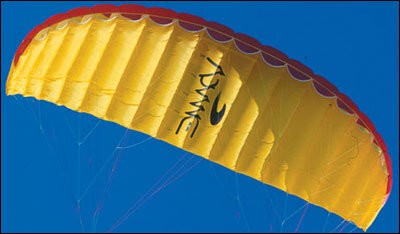 The advance offroad is marketed as an all purpose land traction kite with a bias towards snowkiting. Advance is legendary in the paragliding world for its high quality and attention to detail so i was keen to try out this kite, on loan from a friend. Looking at the offraod you soon notice the differences compared to foils from other manufacturers. for example, all stitching and seams on the offroad are internal, allowing for a very clean profile on the airfoil. also, there is comphrensive internal bracing with diagonal ribs and einforcements plus a very comphrensive bridal system which completely elimates 'bowtieing' (wingtips tucking under the bridles). More on this later. Construction/details The material itself is interesting, very thin and crispy to the touch but extremely light and stretch resistant. The kites also well vented with large openings along the leading edge causing speedy inflation and elping to prevent tucking under at the edges of the window. Flying Unfortunately due to time constraints i wasnt present when the kite was trimmed but Ross, the kite's owner reports it was difficult to set up the brakes properly with the kite regularly overflying the window nd collapsing at the zenith. However he persisted and i can report the offroad flys very well. In terms of handling, it reminds me of the PKD century series, that is; light feeling on the controls, responsive and maintaining good speed through the air. The pull remains constant through the turn and the kite does not flex at all when turning, only the trailing edge moves thanks to that unusual and effective bridle system. It has to be noted it takes a great deal of brake to hover the kite, gradual pressure on the brakes only serving to increase the lift and pull available until approximately the last 1/3 of brake travel. Bearing this in mind i feel this kite is a prime candidate to be put on a bar with depower, no mods are needed part from connecting up the lines and jumping and speed control would be greatly increased. Turning is very impressive, rivalling the firebee for the title of fastest turning 4m kite. The overriding impression is of smoothness and speed, all very controllable and predictable. It really is very nimble for it's size. The only disappointing aspect about the offroad is he compartive lack of lift compared to say, a 4m blade. But as previously stated, i think putting it on the bar will unlock the rest of the offroads performance. On handles there's just too much brake pressure required from your wrists for jumping in average winds. Conclusion With genuinely outstanding build quality and some innovative features, it's easy to like the offroad especially with it's nimble handling. I think it'd make an ideal board or buggy engine that'll last for eternity. My only concerns are the difficulty in trimming, and it's high RRP in the u.k. compared with other 4m kites, so as always, shop around for a good deal. By : bushflyer
 -
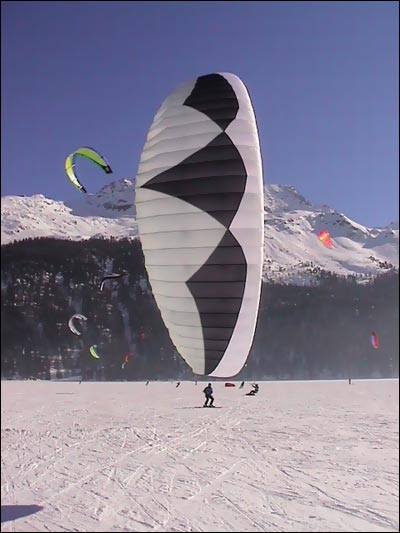 Ever heard of advance kites? No, thought not. Neither had I till earlier this year when I first saw footage of Pascal Jouberts minute long jumps snowkiting. Something like that makes you sit up and take notice. And so the search began to find out more about advance. This proved easier said than done, owners are scarce here and product info pretty much the same. Most owners are paraglider users as well and word of mouth was quality is very high, a step above other manufacturers. There's also the matter of multiple wins in snowkiting including a couple of winter tours and things looked good. At this time, a new model was announced, the Diablo, for snow, water and land use. I needed a lightwind landboard kite which could also be used on the water well powered so an order was placed... Construction/details Opening the nice big box from the postman the kite comes in a drawstring like rucksack which folds into a waistbag; a nice practical touch. Looking at the kite, one can see it is a 4 line bridled depowerable foil, similar in concept to kites such as the boom vector,ozone frenzy and such. Where this kite differs is in the execution. Looking at the foil itself, one can see the fabric (high spec Porsche marine cloth) is thinner and lighter than your regular kite. The stitching is internal, helping to stop snags and keeping the drag down. The seams themselves are glued and taped, so water launchability should be good. The ribs have a mylar reinforcement helping to keep the profile as does the T.E. moving along to the tips, there are drainage channels as well as Velcro panels covering pop off type valves. At the bridles there are carbon battens attached to the A, B, & C lines with pulleys below to control the AoA. The product blurb promises better bar feedback and lighter pressure with this system, we shall see. The bar itself is the same as on the depower version of their previous kite, the Rhea, a straight carbon affair nicely finished in neoprene but a little big (cm) for my taste, I'm used to the frenzy's. However, one problem: no instructions to speak of. The supplier, Airborn of Sweden was kind enough to send the kite with lines pre- connected but at this price level its not too much to ask for a decent manual which covers what you need to know on those trial flights. There is a manual for the rhea online, but this is for the non depower version which doesn't exactly cover everything...however the overall impression of the product leaves you feeling its money well spent, the execution on the foil itself is excellent. Lets see how she flies... Land use The first round of flying involved some time static flying and on my mountainboard in winds ranging from sub 10 to 18mph. for the first flight I held up the kite for about 30 seconds to pre-inflate approx 1/3, this later proved unnecessary. Pushing forward on the bar sent the bird towards the top of the window quite slowly, the tips needing about another 10 seconds to inflate fully. Turning on the kite felt crisp and it was manageable in the fresh (circa 15mph) wind that morning. I tried a few gentle pulls on the bar and the kite picked me up without too much fuss, so all signs were looking good for trying the kite with the board. That afternoon and several outings later I was able to try the diablo out landboarding. Whatever the wind, the overriding impression is of grunt. Effortless grunt. Working the kite below 10 mph unhooked boarding and small jumps are possible, the kite responding accurately to control inputs, turning tightly on its tips with the bar cranked over. The kite seems to specialise in maximising apparent wind. At around 10mph, depower can be used, and the character of the kite changes somewhat. The problem lies in that above this windspeed, the amount of lift the kite generates makes it difficult to hold an edge on your landboard. This wouldn't be a problem if the kite had better low speed ability, but unfortunately the Diablo doesn't handle as well near the bottom of its windrange. With the frenzy for example, there is a comfortable 'grey area' in the wind range where the kite performs well and can be flown in either 2 or 4 line mode (depower/unhooked), the Diablo doesn't have this. It feels sweet 2 line up to around 10 mph, but at this point its physically difficult to hold down so a switch to depower seems a good idea. Around this speed the kite is very sensitive in pitch on the bar, and can nose over and luff easily, not the greatest thing on an 11.5m kite on land I can tell you. The stalling point seems very close to what you can manage power wise on land, so the window of usability on land depower wise is very narrow. Also discovered at this point is that if slowed at zenith the tips fold and the battens can tangle, leading to a reopening in the centre of the window. This was genuinely unsettling and could be a more regular occurrence in dirtier air, the Diablo did not seem to like lumpy winds at all, and was easily unsettled into a nose down situation. The kite needs to be kept moving all the time, as during a drop in line tension it cannot support the weight of its battens. This can cause problems during gybes (particularly jumping/spinning ones) and if not redirected enough on a jump. Then you have to get out. Fast. Water use Initial kitesurfing was done down at Hayle, Cornwall in an ideal 15mph cross onshore breeze. Launching has to be done hooked in due to the arrangement of the safety on the bar. There is no 'chicken loop', but a webbing strap which has to be larks headed over your harness hook. To this the bar attaches, but its near impossible to reconnect on the move. Once up and out, its apparent that this is the kites forte. Power is there all the time, the kite flying far forward in the window, edging upwind easily. Available depower is very good, the kite manageable up to its maximum range. Its interesting to note though that when turned really hard its possible to stall the kite, there seemingly being too much of the turn done on the mainlines. The kite can still overfly very easily if not checked regularly, and if you suffer a crash it takes a certain knack (blame the lack of instructions) to relaunch well, releasing the bar on the safety and grabbing one side of the Y line. Its not as effective as the system from flysurfer et al as it needs more imput, but its okay. The kite floats for a long time, as I found out after relaunching after 3 hours on the water (the joys of being an beginner kitesurfer) and drains the water in about 5 mins or so once airborne. But the exiciting bit, jumping.. takeoff is very smooth, there is no sudden jerk or pop but lots of instant height and long float times. Power delivery really is very linear, and the added resistance of the water lets you boost some very large airs. The overriding impression is of smoothness encompassing a very fast and direct package. On the water its faster than the average foil but everything just feels speeded up, a little sharper and more sensitive than most other kites. Personally I found the bar pressure a little too light, as it was difficult to feel the kites responses in pitch at times. But the jumping... wonderful, with lots of height and floatiness. Takeoff is not the usual sudden jerk, but very smooth and controlled. This does not however mean that is slow, far from it. The general feeling is that of flying 10% faster than you usually do. Conclusion Advance ownership has proved to be a bit of a mixed bag. The kite has not proved to be the all surface weapon it was originally marketed. I have to say I have reservations about snowkiting with it in turbulent mountain air. There was also an issue with premature wear on the bridle lines, both near the batten attachment points and further up with fraying and splitting on the bridles. This was after less than half a dozen flights. While all credit must go to my suppier, Airborn for looking into the matter Advance were not exactly helpful with their flagship kite and were slow to respond, meaning I was stuck with a broken kite for quite some time. And no instructions means no troubleshooting advice, setting up/trimming info and so on, leaving unanswered questions. This isn't to say I don't like the kite. When it works, it works very well but isn't a practical everyday landboarding kite (it needs clean air to work well) and requires you to keep an eye on it all the time. For my personal flying style, I like to be able to take my eyes off the kite to do other things, like board-offs, but on land you don't have the confidence to do this. For those that like technical flying kites this kite would be ideal but I cant help feeling that for 90% of us, a small drop in absolute performance would be well worth it for an increase in low speed stability and lighter weight. Then the kite could tap into the potential of its design. By : bushflyer


