

Aspect Ratio is defined mathematically as the span of the kite squared divided by area. In simpler terms it is the length of the kite divided by it's width. It roughly relates to the amount of lift that a kite produces compared to its drag. Sometimes Aspect Ratio is quoted in terms of projected area, this is when the kite is actually flying and the canopy is curved rather than lying flat on the ground.
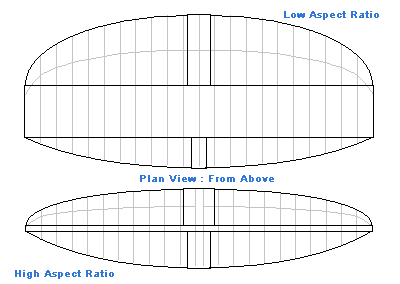
The image below show the plan view of two different kites. The top one has a lower AR than the bottom one, a high AR. In simple terms the longer and narrower the kite, the higher the aspect ratio will be. The shorter and wider the kite the lower the aspect ratio will be.
https://www.extremekites.org/uploads/rk/reviews/586_ar.gif
Aspect ratio, in part determines the performance characteristics of a kite. Some people believe that the higher the aspect ratio of the kite, the more performance it gives. This can be argued in theory, but can also be misleading.
Aspect ratio is a strong determinant of the amount of drag on the wing, the deeper the sail the more drag. This is especially true in aerodynamic theory and when dealing with an extremely efficient airfoil. Kites are not as sophisticated as a high speed airfoil, and therefore aspect ratio is not necessarily the main source of drag for kites. The flying line for example and its diameter create a large amount of drag.
Here are a few general conclusions on aspect ratio:
1. High AR is absolutely the way to go for larger kites because it increases the speed of the wing. This makes larger kites turn faster and therefore easier to control. Most kites in a model range will typically have decreasing AR as their area or size decreases.
2. High AR for small kites is more a hindrance than a help if you are a novice pilot. It can make smaller kites unstable and likely to over-fly the wind window.
3. Low AR kites are much easier to re-launch than high AR as they can more easily roll over. The high AR kites can tend to get stuck on their leading edges.
The profile a kite has also plays a huge part on the overall performance. A thin profile generally makes a kite that flies fast, good for racekites. A thicker profile gives a slower kite however typically more lift. The shape of the profile is also very important, two profiles with the same height, however with very different aerodynamic shapes will behave very differently.
The image below shows two different profiles, the first, allegedly from a Flexifoil Blade and the second from a speed foil. They are very similar in size, however very different in shape so will behave very differently.
images/theory/profiles.gif
Angle of Attack also plays a large part in performance. The characteristics of any kite is usually a trade off between the AR, AOA and the profile. if you play about with these 3 things you can radically change how a kite flies. See the AoA article found under the HowTo section for more information.
A buggy racekite, such as the Ozone Razor typically has a relatively large AR and a thin profile and a small AoA, therefore it flies quickly through the air and doesn't generate lots of lift.
The Flexifoil Blade has a large AR, however has a slightly thicker profile and a slightly larger AoA, this enables the Blade to fly relatively quickly however generate more lift than the Razor.
Beginner to intermediate kites such as the Flexifoil Bullet and Ozone Samurai display more compromises between the 3 values, medium high AR makes them stable and an average profile generates some lift, but not huge amounts and finally, the AoA is tuned to give the best performance.
There are many other attributes that come into play when designing a kite, however these are generally the most important and the easiest to understand in terms of the effect they have on the performance of a kite.
By : racekites

Recommended Comments
Join the conversation
You can post now and register later. If you have an account, sign in now to post with your account.