

Pansh Race Kite (prototype) : Size 4.5m
I was lucky enough to recieve a prototype of the soon to be released Pansh race kite. At the time of writing it does not have a name, only a number. The kite came to me in the usual stuff sack without lines and handles, so I put on Flexifoil handles and a set of 20m generic lines to test the kite.
Initial Impressions.
First impressions seem to be quite important and what struck me about this prototype was the finish. This kite had features which I'd expect on a much more expensive kite and I wasn't expecting to see on a Pansh kite. The material was something different as well, totally unlike the Blaze I own already. More about the material, features and construction later.
Laid out on the beach the high aspect was apparent with a wingspan of 4.9m gave the kite an imposing look on the ground as it sat up ready for flight.

Fair to say that my first impressions of this kite before flying it were very good.
Material and Construction.
The fabric used in this kite is very soft compared with other material I have seen and handled. It has a slippery texture to the touch which must make working with it a nightmare. I did a few highly scientific tests on the material. I gave the fabric a reasonable tug parallel with weave and it deformed only very slightly. However, it returned to shape almost immediately. This is just as good if not better than some of my other kites from better known manufacturers.
The second test. I put the material upto my mouth, formed a seal and blew as hard as I could. I didn't detect any air getting through the material at all. Excellent! but then there shouldn't of been any anyway. Another tick in the box though.
Third test, water. Pouring water onto the material it beaded up and ran off with very little absorbed. This material is far more waterproof than the previous offering.
I think it's fair to say that the material is in many ways superior to the fabric used in the construction of the Blaze.
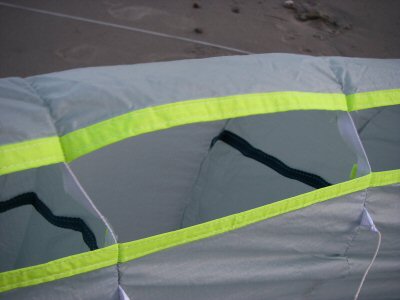
Something we are not used to seeing on Pansh kites is any tape around the edges to reinforce the cell openings or trailing edges. The prototype is fully taped round the cells as well as on the wing tips and on the trailing edge.
In the picture you can see some additional stiffening inside the cell opening which help to keep the cells open. In practice this seems to work very well. Even when there is hardly any breeze the cell openings are wide and proud ready to take advantage of any whiff of a wind.
One of my criticisms of the early batch of Blaze kites were the bridle attachment points. They were sewn directly onto the main canopy material without any reinforcement.
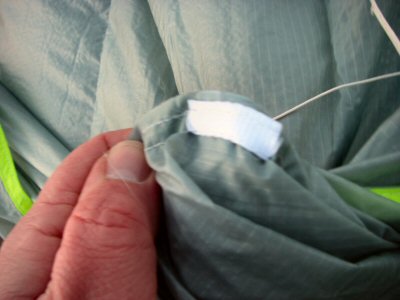
The prototype has an extra tab of webbing inside through which the seam is sewn and the bridle attachment web is attached. This appears to be a much stronger arrangement than previously.
Overall the stitching seems to be of good quality, straight and true. I didn't find any loose threads or areas where the stitching had missed it's intended path. Quite remarkable, considering the slipperiness of the material. The bridles are also stitched with double stitching at all the right places in the kite.
Another feature of the kite that was a surprise was the "Dirt Outs" at the wing tips. I hope this feature is continued into production on both the "luxury" and "standard" models because the prototype has 8 closed cells on each wingtip.
With so many closed cells I was worried about the cross venting between them and how well the tips would inflate. It would not be long before I would find out.

First Flight.
I haven't any pictures of the kite in flight as the ones my friend took were not suitable and the battery was flat in my camera the next time out. I'll add some when I get a chance to fly in some decent weather. The first flight was in blustery conditions on Port Erin beach. Once all the lines were adjusted and I set the brakes to a comfortable length I was ready to see what the kite could do.
Adjusting the brakes wasn't as precise as required for the Blaze and I decided on a length that would allow me to land the kite backwards, but not fly with any brake dialled in.
The kite took off smoothly and flapped it's way to the zenith while the tips were inflating. I must admit I was a touch worried at this stage about the tip inflation. A couple of short passes across the top of the window and the tips inflated enough to form a stable canopy above me. Hooked into the harness through the strop line I had a conversation with a couple of friends who had joined me on the beach (without cameras ... sheesh) while the kite sat there good as gold without any need to keep an eye on it. That sort of stability I like. It gives me confidence that the kite won't try anything tricky when I get moving.
On the landboard the kite powered up smoothly, and kept on pulling. I was travelling much quicker than my nerve could handle on the landboard and I'd hardly brought the kite into the power. I needed lighter winds, I decided, so see just how fast this kite would fly.
A couple of times during that first session it folded a tip and collapsed. When it opened out it wasn't a dramatic turning on of the power. The pressure lost from the tips allowed the kite to power up more gradually as they re inflated themselves. I must point out that a Bullet being flown at the same time couldn't stay in the air more than a few minutes without balling up and trying to kill it's pilot. Tricky conditions and I was confident with the kite as I raced up and down the beach.
Second Flight.
The weather wasn't especially kind over Christmas, so it was a while before I got a chance to get out again. In the meantime I had a email from Pansh with a revision to the bridles. The revision flattened out the foil shape and lengthened the brake bridle. With the adjustments made I took the kite out to the beach again. This time in lighter conditions.
The adjustments made a huge difference. The tips didn't fold once the entire session, and there seemed to be more pressure in the wing tip cells. With the lighter winds I could test the agility of the kite and it's ability to produce power. Turning the kite with a combination of push pull and brakes I could turn it on a wing tip. Flying across the window it generated enough power to scud my carcass up the beach.
There wasn't quite enough power to get any reasonable speed up on the landboard, so I resorted to my 8.5m Blaze which was just about coming on song. The fact that the race kite half the size of the Blaze did get me rolling says something about the generated power. My mate turned up with his buggy and setup a 3.6 Beamer II. Woefully underpowered he was, not a chance of getting anywhere at any reasonable speed. So being the good sport I am I gave him the prototype to have a try with.
He hopped in his buggy and was off! No problem at all, good speed, no luffing and this chap is relatively new to buggying. It also gave me a chance to have a closer look at the foil shape. Close up, it looked smooth and well formed. I didn't see the prototype for an hour after that because my mate wouldn't give it back. Huge grin on his face when I eventually flagged him down.
Conclusions.
This is going to be an interesting kite when it comes to market. Because of the poor weather I didn't get a chance to do any speed comparisons. The "luxury" model has the material of the prototype and in my opinion it is a much better material than the original. It takes shape quickly and holds that shape, as well as being lighter and having greater water resistant properties.
The bridle material is going to be changed for a thinner material on the luxury model, I am told, but I have yet to see it. This has got to be a good thing to reduce air resistance.
I don't know if it will be competitive on the race circuit, but as a buggy engine and as a speed engine on a landboard I'm impressed. When I get a chance to get pictures of the kite in flight and do a speed comparison I'll report back.
Update.
Just a quick update with a couple of pictures of the kite in flight. I'm not flying due to injury at the moment but I took the kite down to the beach and hooked up a mate so I could get some pics.


Recommended Comments
Join the conversation
You can post now and register later. If you have an account, sign in now to post with your account.