

Kite killers represent one of the most significant introductions to kiting equipment in recent years. Cited as a 'safety device' this can only be so if they are fitted and used correctly.
There use is a matter of personal option, but this decision should be based on a reasonable assessment of the risks which go with kite flying. I would say all new flyers should use them, and more experienced pilots may benefit from there use when checking out a new kite. But it's true to say that there is a point where they can become a hindrance to truly confident flyers. People in that position will be able to make their own decisions, and probably don't need to read this anyway.
So where's the safety benefit?
It's reasonable to say that the most tangible benefit is realised not by the kite flyer using them, but by other people around him. Their use helps to ensure that in the event of it becoming necessary to release a kite it there is less risk of it becoming a hazard for other people. Normally un-tethered kites will come down in reasonable time over a reasonable distance, but not always. I have personally experienced having a 3.2M kite tugged out of my grip only to have it travel some 75m before it came to rest, and that only because it reach the shoreline and was stopped by the waters edge. With this in mind it's not beyond the wit of most to consider that the stopping force 75M away could have been anything, or anyone. Maybe a car travelling alongside the flying site, or a small child enjoying the beach with the family.
The potential is enormous and statements such as 'there is no evidence of such an occurrence' is like saying it hasn't happened so why should we prevent it from happening. Coupled with this is a less obvious safety advantage, that of the confidence of the pilot. Arguably with hundreds of pounds worth of kit on the ends of a few pieces of string some people may be driven to not want to risk potential damage to their kite if they let it go. This could easily render the pilot at risk due to being overpowered with all that that implies. The decision to let go of handles has to be made in a split second, and if that decision is clouded by fear of damage to a kite then it may not be made in time. By using kite killers the pilot may be happier to make this decision earlier, possibly before they leave the ground, get dragged off their board or out of the buggy unintentionally.
How are they used?
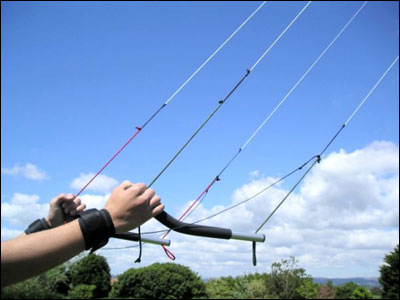
To date nearly all kite killers are the same basic system. A line of sufficient strength is connected to the brake lines on a four line kite in a certain place, the other end in connected to a strap which fits on the wrists of the pilot, as shown here:
https://www.extremekites.org/uploads/rk/reviews/kitekillers01.jpg
The attachment point of the killer line to the brake line is important. In the image above they are attached via a larks head to the brake lines over the sleeved section, and pushed up tight against the knot on the end of the handle brake line leader.
This forward attachment point is important. In simple terms there must be enough scope of length on the system to allow the kite to lie on its back completely when the killers are deployed. If the killer lines are attached to the same point as the stake loops (visible on the bottom of the handles in the image above), then it will still allow the top half of the kite to be exposed to the winds and therefore has potential to withhold power.
One important thing to consider is the length of the killer line. If this is too long it can become a hazard in itself, either by snagging on the other handle, or by becoming trapped on buggy wheels etc. To help prevent the latter there is no doubt that some awareness of the kite lines needs to be employed. Arms should be held up to minimise the risk of retained lines winding around the axle of a buggy in motion. I can reveal that there is a new handle design on the way which reduces the killer line length to an absolute minimum, but that's another story.
There are two basic ways to attach existing killer lines. The first is as shown in the image above, here's a detailed photo of this version:
https://www.extremekites.org/uploads/rk/reviews/kitekillers02.jpg
And here's a two knot version which is my personal preference:
https://www.extremekites.org/uploads/rk/reviews/kitekillers03.jpg
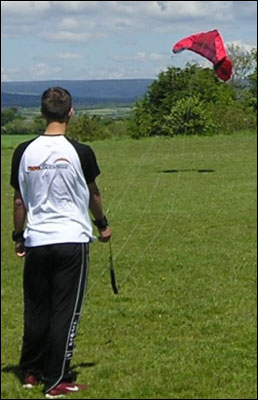
When the handles are let go the kite should look like this:
https://www.extremekites.org/uploads/rk/reviews/kitekillers04.jpg
In this example you can see that the kite has depowered so much that the lines have become totally slack
https://www.extremekites.org/uploads/rk/reviews/kitekillers05.jpg
The kite should become nothing more than loosely flapping laundry, if there is any retention of the shape of the foil the killer attachment point needs adjusting.
The handles them selves will fall forward and adopt a position like this:
https://www.extremekites.org/uploads/rk/reviews/kitekillers06.jpg
Which reveals another advantage of the use of killers. Rather than the handles being catapulted off into the distance, with potential for impacting things and the risk of line tangles, they can be recovered once the kite has come to rest. Usually only a couple of turn may be needed to take any twists out of the flying lines, and the kite can be gently tugged back into a forward or reverse launching position and play can continue. In the event of the kite being too far out of shape then stake the handles, remove the wrist straps and make your way to the kite to sort it out. Be careful at this point, it is perfectly possible for the kite to be blown into a position where it will self reverse launch, with potential for you to get caught by the lines if you are too close or unaware of the kites actions. Some say that staking through the killer straps will remove this problem, however the kite may not stay in shape flat on the ground, and can become airborne because the trailing edge has lifted. At least by staking through the stake loops the kite can be arranged in the parking position minimising the risk of an unplanned launch.
So that's about it, it's a simple system, and set up correctly can represent a significant safety improvement.
By : Jerry





Recommended Comments
Join the conversation
You can post now and register later. If you have an account, sign in now to post with your account.